Class 8 English - Poorvi (NCERT New Book 2026-27)
Chapter 8: The Magic Brush of Dreams
Detailed Notes A-Z (Easy for Students to Understand)
Hello students! This chapter is a beautiful poem from the unit "Mystery and Magic". It is adapted from an old Indian folk tale. The poem teaches us important lessons through a fun, magical story. We will cover everything step by step: pre-reading, full poem with simple explanation, summary, word meanings, themes, literary devices, and all answers to the book questions. No confusion – just clear, simple language like your teacher explaining in class!
Pre-Reading Activities (Warm-up before the Poem)
Before reading the poem, the book asks you to discuss these in pairs:
- Mention a magical object that you would like to have. Give a reason. (Example: I would like a magic pencil that makes my drawings come true because I love drawing my dream house!)
- What would you draw for yourself if you had a magic paint brush? Why? (Think: food, toys, a bicycle, or a school with no homework!)
- Would you use the magic paint brush to draw for someone else? If yes, why? If no, why not? (The poem shows why helping others is better!)
- Discuss acts of kindness you have seen or heard. (Example: Sharing food with a hungry friend or helping an old person cross the road.)
- Guess meanings and draw pictures of these words: paintbrush, joy, fortress, feast, fear, winding, twig, bows, drawing, cold. Then sort them into: Things / Actions / Emotions.
Why do this? It gets your brain ready for the magic and kindness in the story.
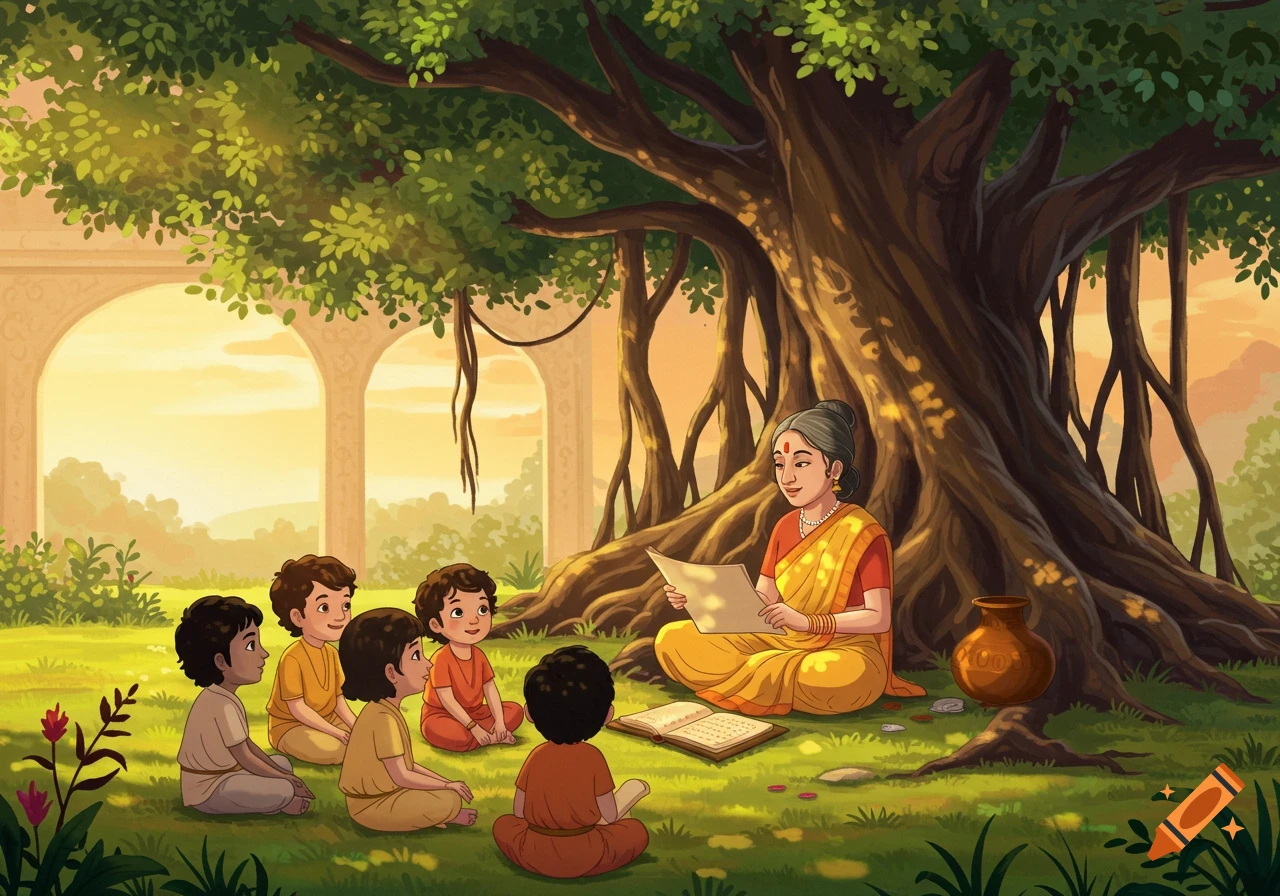
(Picture above: A girl sitting under a big banyan tree – just like Gopi in the poem! Imagine her drawing in the sand.)
Full Poem: The Magic Brush of Dreams
(Exact words from the NCERT Poorvi book)
“Go and gather wild beans, Gopi, Go and fetch some rice. Go and pluck the mangoes And bring home something nice.”
Gopi sits beneath the banyan, A twig is in her hand. She sits there drawing pictures, Pictures in the sand. The winds blow by and sweeps away The pictures in the sand.
But on a stone there sits a man, A brush is in his hand. He looks around. He calls to Gopi. “Come here!” he whispers. “Hush! We mustn’t let the village know About this magic brush.” He slips the brush into her hand And tells her to be sure, “Paint not for the wealthy ones, But only for the poor.”
“Did you gather wild beans, Gopi? Did you fetch some rice? Did you pluck the mangoes And bring home something nice?”
“No beans, no rice, no mangoes!” Gopi grins and runs inside. She paints a bowl of khichdi and waits, Until the paint has dried.
“The bowl is full of khichdi, Gopi!” Into the house the villagers streamed The young and old all wish to see The magic brush of dreams.
She paints a muffler for a farmer, A plough for another man, A shawl for a grandmother, And for a girl, a fan.
And soon the news spreads far and wide, Through forests, fields, and plains, Until the Zamindar himself Hears of these magic gains.
“I order you to paint for me, A fortress tall and grand. Paint treasures, jewels, and riches rare, Enough to rule this land.”
Gopi bows and shakes her head. “My lord, I can’t comply. I swore to use this magic brush To help the needy by.”
The Zamindar roars and stamps his foot. He bellows to his men, “Seize this brush and seize the girl. Throw her in the pen!”
Now Gopi waits inside the cell, Upon a cold mud floor. Until the Zamindar returns And shouts through the door.
He holds the brush. He thunders loud, “Paint my fortress tall! Paint gold and rubies, emeralds bright, And you shall leave this hall!”
That night the Zamindar lies in bed, Dreaming of his gold, While Gopi paints a winding road, A horse both strong and bold. The road leads out of prison gates. The horse, she swiftly urges Gopi leaps on and gallops fast, Through fields and many villages.
“It’s Gopi! It’s Gopi! She’s back again!” Say the villagers, merry and kind. But Gopi keeps on painting still, With the Zamindar’s men following behind.
She paints a mighty river wide, Its currents fast and deep. The Zamindar and all his men Stop short and cannot leap.
“Now should I paint a beast To leap and chase you through? Stop this chase or it will feast On you, and you and you!”
The Zamindar cries, “No, no, no more! I’ll leave, I’ll go away!” He turns and flees; his men behind Dare not choose to stay.
Now Gopi paints for the village folk, A feast of sweets and tea. A courtyard bright, a band to play, And songs of victory.
Adapted from a Folk Tale
Simple Summary (In Your Own Words)
Gopi is a poor village girl. Her mother asks her to bring food, but instead of working, she draws pictures in the sand with a twig. A mysterious man secretly gives her a magic brush and says, “Use it only to help poor people, not rich ones.”
Gopi paints a bowl of hot khichdi – it becomes real! Villagers come running to see the magic. She happily paints useful things for poor farmers, grandmothers, and children. News reaches the greedy Zamindar (rich landlord). He orders Gopi to paint a huge fortress full of gold and jewels for him.
Gopi refuses because she promised to help only the needy. The angry Zamindar throws her in jail. But clever Gopi uses the brush to paint a road and a strong horse. She escapes! The Zamindar and his men chase her. Gopi paints a wide, deep river and even a scary beast. The bad men cannot cross and run away in fear.
Finally, Gopi returns to the village and paints a big feast, music, and joy for everyone. The poem ends happily with songs of victory!
Moral of the Story (Very Important): Kindness and helping the poor always win. Greed makes people lose. Imagination and art can solve problems and bring happiness.
Stanza-by-Stanza Easy Explanation
- Beginning: Gopi is lazy about chores but loves drawing.
- Magic Gift: The kind stranger gives her the brush only for poor people.
- First Magic: Khichdi appears – everyone is amazed!
- Helping Poor: She paints tools, clothes, fans – pure joy!
- Greedy Zamindar: He wants everything for himself.
- Refusal & Jail: Gopi stays brave and honest.
- Escape: Road + horse = freedom!
- River & Beast: Smart way to stop the chasers.
- Happy Ending: Feast and celebration for the whole village.
Word Meanings / Glossary (Simple Hindi + English)
- Khichdi: खिचड़ी (mixed rice and dal dish)
- Muffler: मफलर (woollen scarf)
- Plough: हल (farming tool to dig soil)
- Shawl: शॉल (warm wrap for old people)
- Zamindar: ज़मींदार (rich landlord who owns land)
- Comply: मानना (obey orders)
- Bellows: चिल्लाना (shout loudly in anger)
- Thunders: गरजना (shout angrily)
- Winding: घुमावदार (curvy road)
- Urges: जल्दी करना (push the horse to run fast)
- Currents: तेज़ बहाव (fast flowing water in river)
- Feast: दावत (big party with lots of food)
Themes (Main Ideas)
- Kindness vs Greed – Gopi helps poor; Zamindar wants only for himself.
- Power of Imagination & Art – A simple brush changes lives!
- Bravery and Honesty – Gopi never breaks her promise.
- Magic in Everyday Life – Helping others is the real magic.
Literary Devices (How the Poem is Written Beautifully)
- Rhyme Scheme: Mostly ABCB (easy to sing like a song).
- Imagery: You can “see” the pictures – khichdi bowl, river, horse, feast.
- Repetition: “On you, and you and you!” (makes it scary and funny).
- Alliteration: “winding road”, “strong and bold”.
- Narrative Poem: It tells a complete story like a ballad.
All Answers to Book Questions (With Easy Explanations)
Let Us Discuss I. Arrange events in order (Book gives last one as 10):
- Gopi is told to gather food but draws in sand.
- A man gives her the magic brush for the poor.
- Gopi paints khichdi – villagers amazed.
- Gopi paints useful things for villagers.
- Zamindar hears and orders fortress.
- Gopi refuses and is thrown in prison.
- Gopi paints road + horse and escapes.
- Gopi returns with Zamindar chasing.
- Gopi paints river + beast – chasers run away.
- Gopi paints feast – villagers celebrate (given).
II. Tone of poem:
- playful and innocent (Gopi drawing happily)
- tension and suspense (Zamindar angry, jail)
- triumphant and celebratory (escape + feast)
III. 1. ABCB 2. narrative or ballad
IV. 1. Imagery example: “A mighty river wide, Its currents fast and deep.” 2. Repetition effect: It shows the beast will eat ALL of them – makes Zamindar very scared!
V. Matching:
- Magic paintbrush → (iii) power of art and imagination
- Grand fortress → (i) greed and desire for wealth
- River and beast → (ii) barriers to protect Gopi
VI. True – This contrast shows the moral: Use power for good, not selfishness.
Let Us Think and Reflect (Extract-based)
- (i) careful and secretive (ii) It shows the brush is special and must be kept hidden from greedy people. (iii) …he wants to help only poor people who really need it. (iv) A. The Magic Brush’s Secret
(Other extracts in book follow the same pattern – always choose the kind and honest option for Gopi!)
Let Us Learn (Grammar/Activities – not fully extracted but typical)
- The poem uses simple present and past tense for storytelling.
- Practice: Write your own “magic object” story using imagination!
Extra Tips for Exam
- Short answer: What does the magic brush do? (Makes drawings real for poor people.)
- Long answer: Why is Gopi a hero? (Brave, kind, clever – never uses magic for selfish reasons.)
- Value-based: How can you be like Gopi in real life? (Help needy friends without expecting anything.)
Final Message for You: This poem shows that even a small girl with a brush can change the world if she uses her power for good. Be kind, use your talents to help others, and never be greedy like the Zamindar!
Practice drawing your own “magic” pictures and share with friends. You will love this chapter – it’s full of magic, adventure, and good values!
Keep revising these notes – you will score full marks easily. All the best, future toppers! 🎨✨