Class 7 SST Chapter 11: From Barter to Money
Hey student! Imagine life without money... How would you get a new pencil or shoes? This chapter is a super story of how people moved from swapping things (barter) to using money. It’s all about why barter was tough and how money made life easy. Read like a story, remember with pictures and short points. Let’s go!
1. What is the Barter System? (Before Money Days)
Long ago (even 6000 BCE), no shops, no cash. People swapped goods directly.
- Farmer gives wheat → gets clothes from weaver.
- You give rice → get shoes from cobbler. Commodities used: grains, beads, stones, vegetables, handmade tools, fruits – anything useful!
Simple Example from Book (Farmer Story): You are a farmer with one extra ox. You need shoes, sweater + medicines for grandma.
- First, find someone who wants your ox AND has shoes? Hard!
- You swap ox for wheat bags → then wheat for shoes, sweater, medicines.
- Carry heavy bags everywhere? Store safely? What if wheat gets wet? This shows barter was slow and full of problems.

2. Why Barter Was a Big Problem? (5 Easy Limitations – Remember "D-D-D-P-P")
Barter had 5 big headaches (double coincidence, no value measure, divisibility, portability, perishability).
| Problem (Simple Word) | What it Means (Easy Example) | Why It Was Annoying |
|---|---|---|
| Double Coincidence of Wants | Both people must want exactly what the other has | Farmer wants shoes but cobbler may not want wheat right now |
| No Common Value | How much is 1 ox worth? 10 shoes or 5? | No fixed price – fights happen |
| Divisibility | Can’t cut ox into small pieces for small buys | Need whole thing or nothing |
| Portability | Hard to carry heavy wheat bags everywhere | Go to market? Back pain! |
| Perishability/Durability | Food rots, tools break | Value gone in few days |
Fun Tip to Remember: Think of a farmer with ox – he faces D-D-D-P-P problems every day!
Activity Idea (Do in Class): Imagine you have only 1 pencil box. List 3 things you need and who you would barter with. What problems come?
3. How Money Solved Everything? (The Hero!)
Money came to fix barter problems. It is:
- Medium of Exchange → Buy anything easily.
- Store of Value → Save for later (won’t rot).
- Unit of Account → Fixed price (1 shirt = ₹200).
- Standard of Deferred Payment → Pay later (like EMI today).
Money made trade fast, fair and far (even with strangers).
4. Journey of Money – Timeline (Super Easy to Draw & Remember)
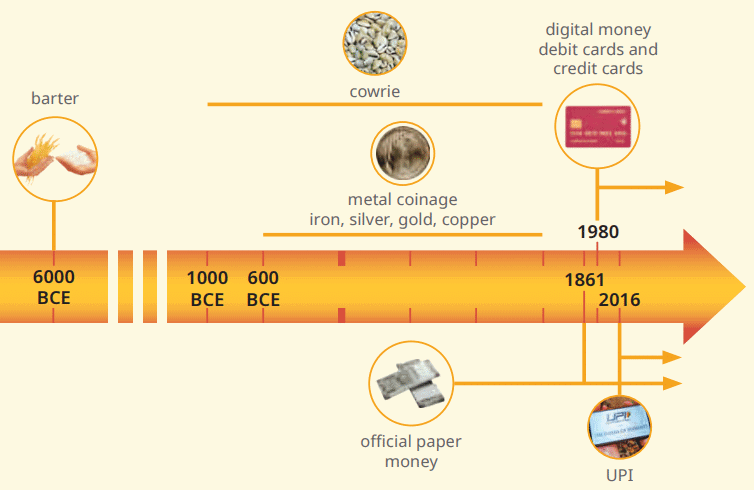
Money changed step by step in India and world. Draw this timeline in your notebook!
6000 BCE → Barter (swap goods) 1000 BCE → Cowrie Shells (small white shells from sea – easy to carry, durable, everyone accepted) 600 BCE → Metal Coins (first coins in India – iron, silver, gold, copper) 1861 → Paper Money (British started notes in India) 1980 → Cards (Debit/Credit) 2016 → UPI Digital Money (phone scan – no cash needed!)
Why Cowrie Shells? Small, same size, hard to break, easy to count and carry in pocket. People even used them in Africa and Asia!
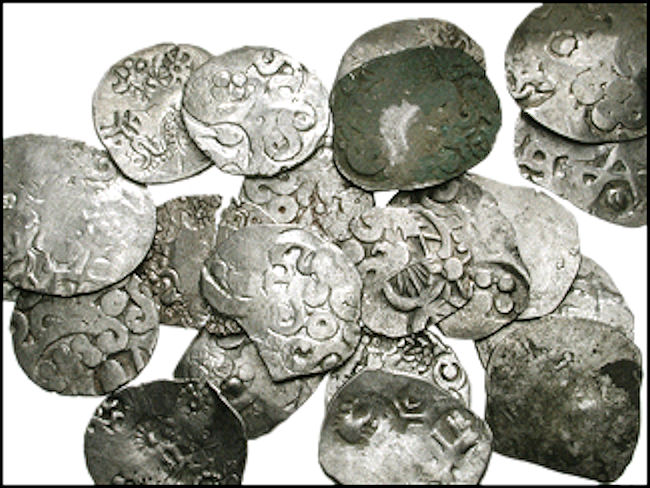
Ancient Indian Coins (Karshapanas or Panas):
- Punch-marked (symbols hammered on metal).
- Made of gold, silver, copper alloys.
- Beautiful motifs (animals, sun, trees) for trust.
- Called “rupas” (symbols).
- From Arthaśhāstra (old book): 60 panas = salary for 1 year = enough for 3 kg grain daily for family meals!
Cool Discovery: Roman gold coins found in Pudukkottai (Tamil Nadu) during digging.
- Means: Ancient South India traded spices, pearls, cloth with Rome by ships.
- Trade was in India’s favour (Romans paid in gold!).
- Shows early “Make in India” power!
5. Modern Money in India Today
- Coins & Notes: Made by Government + Reserve Bank of India (RBI).
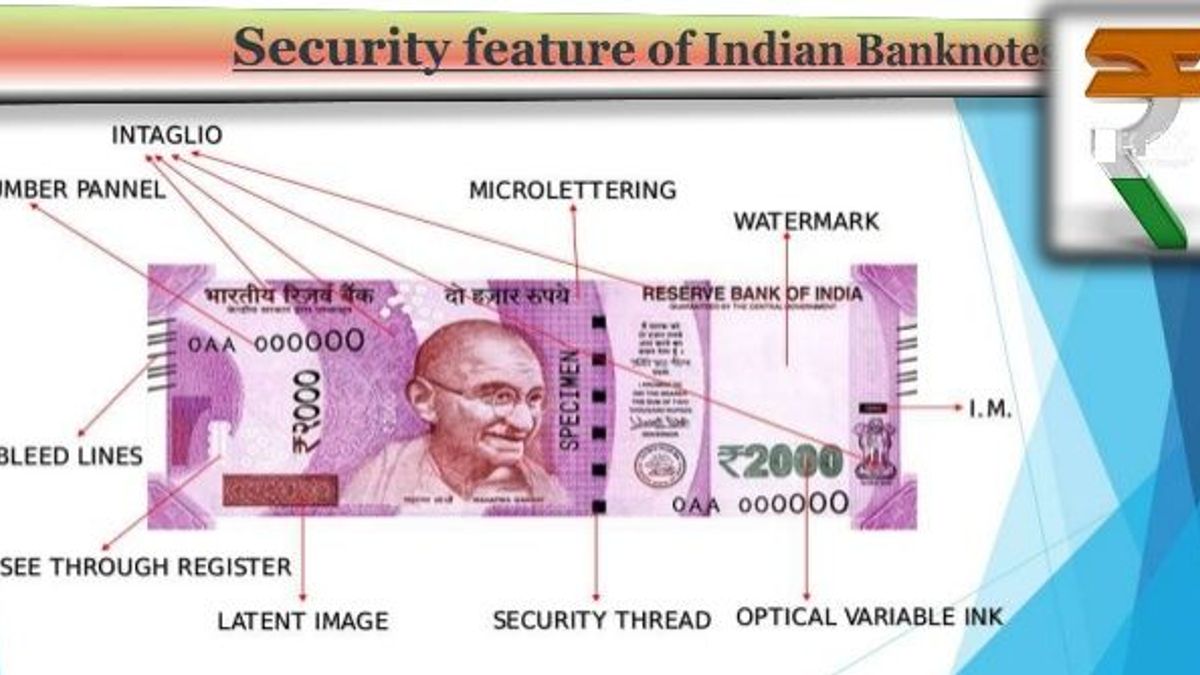
- Security Features (to stop fake money – remember “W-S-M-O”): Watermark, Security Thread, Micro-lettering, Optical Variable Ink.
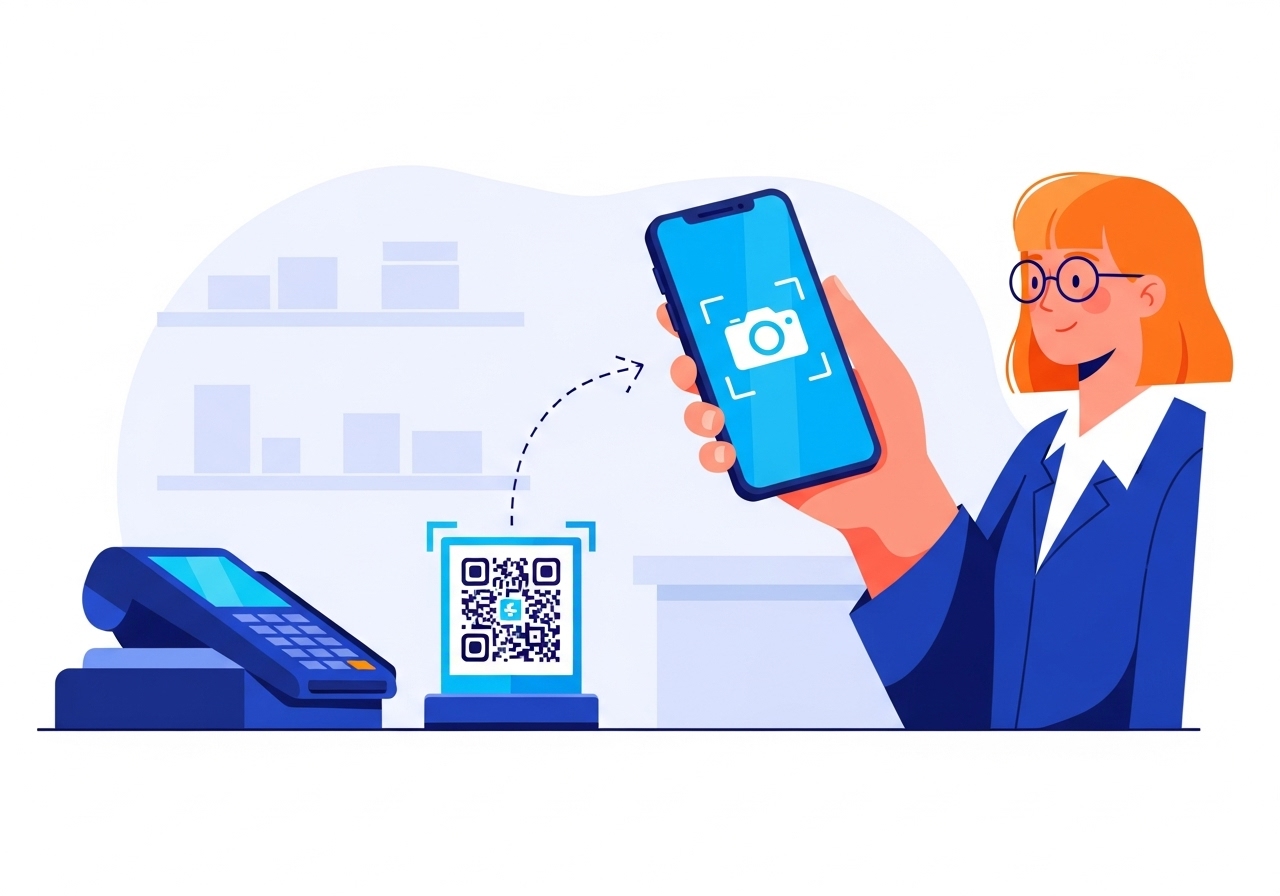
- Digital Money: UPI, PhonePe, Google Pay – scan QR, money goes instantly from bank to bank. No cash, safe, fast!
Why People Love UPI? Quick (2 seconds), no need to carry notes, works everywhere in India. But some still use cash for small things or villages without good phone network.
:max_bytes(150000):strip_icc()/INR4-4a0d97c5a50e453db97e2e3487c817a3.jpg)
6. Still Barter Today? (Yes, Little Bit!)
- Old clothes for steel utensils (vendors come home).
- Book exchange in school library.
- Junbeel Mela (Assam fair) – swap local goods. Good Side: Saves money, less waste, fun community. Problem Side: Value fight, hard to match needs.
Quick Revision – One-Line Memory Tricks
- Barter = Swap goods (but D-D-D-P-P problems).
- Money = Magic fix (medium + store + unit + deferred).
- Cowrie → Coins → Paper → Digital (India timeline 6000 BCE to 2016 UPI).
- Ancient Coins = Punch + Symbols + Trade proof (Roman coins in Tamil Nadu).
- Today = RBI safe notes + UPI on phone.
Group Activity (Book Style): Collect 5 old coins from family. Note: metal, year, pictures on both sides. Guess story behind them (old king? Freedom fight?).
Important Questions for Exam (Practice These!)
- What is barter? Give 2 examples + 1 limitation.
- Explain any 3 problems of barter with farmer-ox story.
- Draw timeline of money evolution (6 points).
- Why were cowrie shells used as money?
- What do Roman coins in Pudukkottai tell us?
- Name 4 security features of Indian notes.
- UPI vs Cash – which do you like and why?
Pro Tip for Student: Draw pictures in margin – barter swap, cowrie pile, coin punch, phone UPI scan. Revise once daily = 100% marks! This chapter shows how money changed society from slow swaps to fast digital life.
You got this! If teacher asks, say: “Money made India’s trade strong since ancient times.” Keep exploring society! 📖✨