Exploring Society: India and Beyond (New NCERT Book 2026-27)
Chapter 10: The Constitution of India — An Introduction
Hey student! These notes are made super simple, like a story, with short points, easy words, and memory tricks. Read once, revise twice, and you will remember everything. No big words, just clear ideas. I have added some real photos and graphics (like from NCERT style) so you can “see” the chapter. Let’s dive in!
1. The Big Question – Why Talk About Constitution?
Imagine Republic Day – parades, flags, soldiers marching, jets flying. Why do we celebrate 26 January every year? Because on 26 January 1950, our Constitution came into force. It is the birthday of our Republic!
Fig 10.1 Glimpses from the Republic Day Parade (shows soldiers, flag, people cheering – symbol of our pride in the Constitution).
The Constitution is India’s rule book. Every big leader (President, Prime Minister, judges, army officers) takes an oath to follow it. It is the supreme law of the land.
Memory trick: Think of Constitution as “Consti-Tution” = Country’s Constitution (rules) + Institution (how government works).
2. What is a Constitution? (Super Simple Definition)
- A written document that has all the basic rules for running the country.
- It tells:
- How the government is formed.
- What powers leaders have.
- What rights every citizen has.
- How laws should be made.
- It is like the rule book of a big game called “Running India”. Everyone – from top leader to common person – must play by these rules.
Why do we need a Constitution? (Easy 4-point list – remember PRUM) P – Protects our rights (so no one can take them away). R – Rules for government (stops misuse of power). U – Unites the whole country (keeps India one). M – Makes sure there is justice, equality and freedom for all.
Without it, there would be fights, unfairness and confusion.
3. How Was Our Constitution Made? (The Real Story)
After freedom in 1947, leaders wanted to write a new rule book for free India.
Step-by-step easy story:
- Constituent Assembly was formed in 1946 (like a special team to write the Constitution).
- It had 389 members from all over India – different religions, languages, rich and poor.
- First meeting: 9 December 1946.
- Dr. B.R. Ambedkar was the Chairman of the Drafting Committee (he is called the Father of the Indian Constitution).
- They discussed for almost 3 years, read books from other countries, and took the best ideas.
- Final draft ready on 26 November 1949 – this day is called Constitution Day (Samvidhan Divas).
- It came into force on 26 January 1950 (Republic Day).
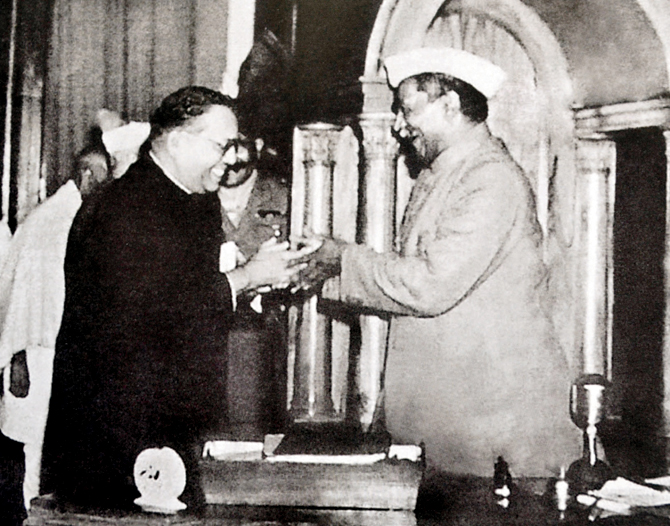
Photo of Dr. B.R. Ambedkar presenting the final draft to Dr. Rajendra Prasad (first President) on 25 November 1949.
Another photo: Dr. Ambedkar with other members of the Drafting Committee (29 August 1947).

Historical photo of Constituent Assembly meeting. (Leaders sitting and discussing the future of India).

Memory trick: 1946 (team formed) → 1949 (draft ready) → 1950 (starts working). Like 1946-49-50 = easy numbers!
4. The Preamble – The Soul of the Constitution
The Preamble is the opening page of the Constitution. It is like the “introduction” that tells the main goals.
Exact simple words of Preamble (learn by heart – very important!): “We, the people of India, having solemnly resolved to constitute India into a Sovereign Socialist Secular Democratic Republic and to secure to all its citizens: Justice (social, economic, political) Liberty (of thought, expression, belief, faith and worship) Equality (of status and opportunity) and to promote among them all Fraternity (assuring the dignity of the individual and the unity and integrity of the Nation).”
Beautiful illustrated Preamble page from the Constitution (with artistic border and national symbols).

Key words in Preamble – Easy meaning:
- Sovereign: India is free – no outside rule.
- Socialist: Government works for equal wealth and welfare.
- Secular: All religions are equal – no special religion for government.
- Democratic: People rule through voting.
- Republic: Head of state (President) is elected, not king/queen.
Memory trick for 4 goals: JELF = Justice, Equality, Liberty, Fraternity.
5. Main Features of Our Constitution (Easy Points)
- Longest written Constitution in the world.
- Flexible and rigid – can be changed when needed but not easily.
- Federal – power shared between Centre and States.
- Parliamentary system – Prime Minister and Council of Ministers run the government.
- Fundamental Rights (6 rights given to every citizen – like right to equality, freedom, against exploitation etc.).
- Directive Principles – guidelines for government to make India better (not enforceable in court but very important).
- Fundamental Duties – things we citizens should do.
6. Why is it Special? (Quick Revision Box)
- It gives equal rights to everyone – no one is big or small.
- It protects minorities and weaker sections.
- It has borrowed good ideas from many countries (UK, USA, France, Ireland etc.) but made it Indian.
- It starts with “We the People” – power comes from citizens, not kings.
Quote to remember (Dr. Rajendra Prasad): “We have prepared a democratic Constitution. But its success depends on us – we must respect others’ views, compromise and work hard with good morals.”
7. Let’s Explore / Activities from the Chapter (Do These!)
- Why do we celebrate Republic Day? Draw a small flag and write one line.
- Read the Preamble and explain any one word (e.g., Secular) in your own words.
- Make a poster: “My Rights as per Constitution”.
- Discuss: What would happen if there was no Constitution?
Revision Trick (A-Z Quick Recall): A = Ambedkar (Father) C = Constitution (rule book) D = Democratic Republic J = Justice, Liberty, Equality, Fraternity (Preamble) P = Preamble + People’s power R = Republic Day 26 Jan 1950 S = Sovereign, Socialist, Secular
You now know the full chapter! Revise these notes in 10 minutes every day. Draw the Preamble or Republic Day parade in your notebook – it will stick in your mind forever.
You are ready for any question – short, long or picture-based! Keep exploring society like a true student. 🇮🇳