Class 7 Science (Curiosity - New NCERT Book 2026-27)
Chapter 8: Measurement of Time and Motion
Full A-Z Detailed Notes (Easy to Remember Style)
These notes are made super simple, with short points, tables, mnemonics, examples, and revision tricks so you can revise in minutes. Everything is explained like a story + quick facts. Perfect for exams!
1. Why Do We Need to Measure Time? (The Big WHY)
- Time helps us understand when things happen (sunrise, seasons, school bell, festivals).
- Without measuring time, we cannot plan daily life, study motion, or understand natural events.
- Easy mnemonic: "Time = Change Tracker" → It tracks changes in position or events.
Key Point to Remember: Time is a fundamental quantity. We measure it in seconds (s), minutes, hours, days, years.
2. Ancient Methods of Measuring Time (Old but Smart Ways)
Early people used natural things to measure time. No batteries needed!
| Method | How it Works | Easy Memory Trick | Limitation |
|---|---|---|---|
| Sundial | Shadow of a stick (gnomon) moves with sun | "Sun → Shadow clock" | Works only in daytime |
| Water Clock | Water drips from one pot to another | "Drip-drop time" | Needs constant water supply |
| Sand Clock (Hourglass) | Sand flows from upper to lower bulb | "Flip & flow" | Fixed time only (e.g., 1 hour) |
| Candle Clock | Candle burns at steady rate | "Burn & mark" | Wind can disturb flame |
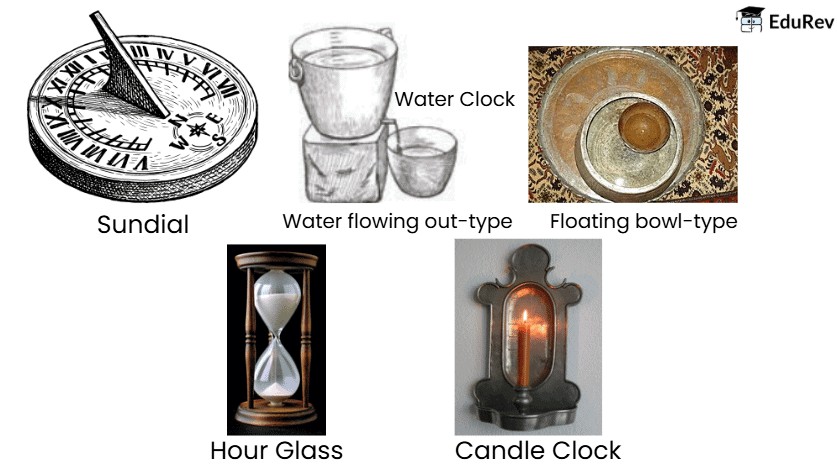
Figure (NCERT style): Shows Sundial (shadow on dial), Water Clock (two pots), Hourglass (sand flowing), and Candle Clock.
Revision Tip: Ancient = Nature-powered (Sun, Water, Sand, Fire). Remember "S-W-S-C" → Sun-Water-Sand-Candle.
3. Modern Methods of Measuring Time (Accurate & Easy)
- Pendulum Clock: Uses swinging bob (back & forth).
- Quartz Clock: Uses vibration of quartz crystal (very accurate).
- Atomic Clock: Most accurate – uses vibration of atoms (used in GPS, science labs).
Do You Know? One atomic clock can be accurate to 1 second in millions of years!
4. Simple Pendulum – The Star of the Chapter! (Must Know)
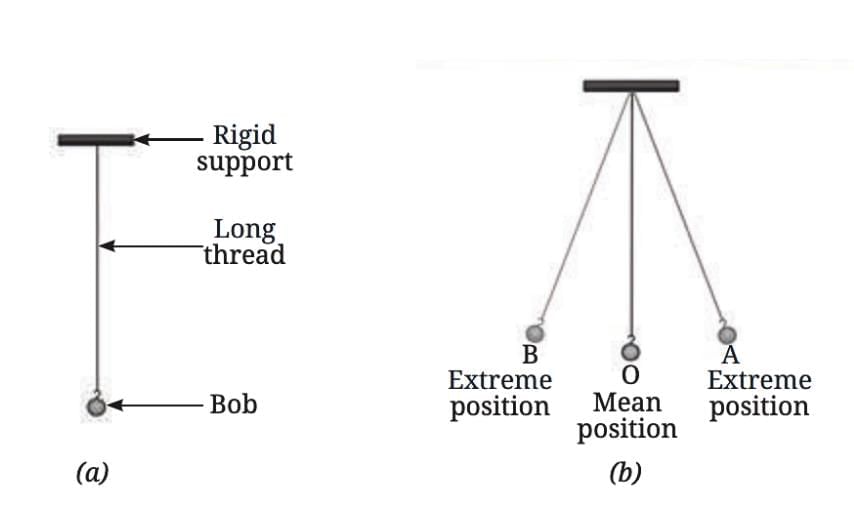
A simple pendulum is a small heavy ball (bob) hanging from a thread.
Parts (Easy labels to remember):
- Rigid support (fixed point)
- Long thread (length = l)
- Bob (heavy metal ball)
Oscillation = One complete to-and-fro swing (from mean position → extreme → back to mean → other extreme → back to mean).
Time Period (T): Time taken for one oscillation. Easy formula to remember: Longer thread → longer time period (T increases with length).
Activity You Must Remember (Do at home!)
- Tie a bob to thread, hang from stand.
- Pull slightly and release (small swing).
- Count 20 oscillations with stopwatch.
- Time period T = Total time ÷ 20.
- Change length and repeat.
Factors affecting Time Period (Super easy table):
| Factor | Effect on T | Memory Trick |
|---|---|---|
| Length of thread | Increases → T increases | Longer string = slower swing |
| Mass of bob | No effect | "Heavy or light – same swing!" |
| Amplitude (swing size) | Small amplitude → T same | Keep swings small for accuracy |
Figure (NCERT style): Simple pendulum setup (left) + positions of bob (mean O, extreme A & B).
Revision Trick: Pendulum = "Length Rules" (only length changes T).
5. What is Motion? (Super Simple Definition)
- Motion = Change in position of an object with time with respect to a reference point.
- Rest = No change in position with time.
Example: You are at rest in a moving bus (w.r.t. bus seat) but in motion w.r.t. road.
Key Point: Motion is relative – depends on reference point.
6. Types of Motion (Uniform vs Non-Uniform)
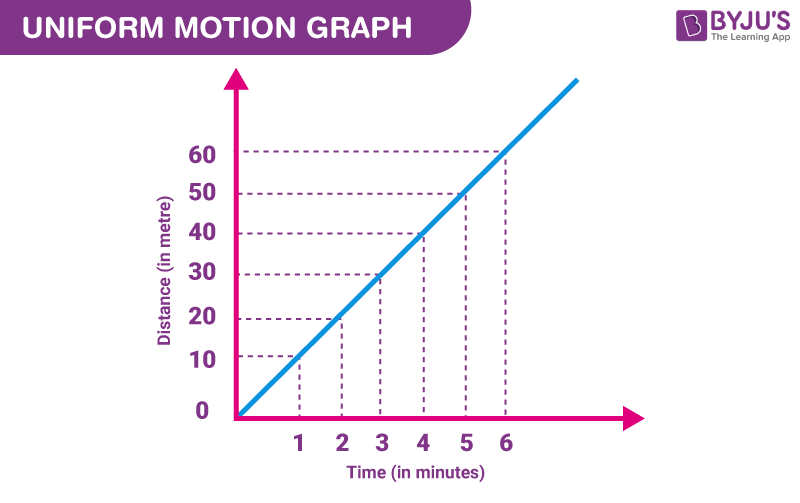
- Uniform Motion: Covers equal distance in equal intervals of time. Example: Car moving at constant 50 km/h.
- Non-Uniform Motion: Covers unequal distance in equal time (speed changes). Example: Car in traffic (sometimes fast, sometimes slow).
Easy Mnemonic: Uniform = "Steady Eddie" (straight line on graph). Non-uniform = "Speedy Gonzales" (curvy graph).
7. Speed – The Measure of "How Fast?"
Definition: Distance covered per unit time. Formula (memorise like ABC): Speed (S) = Distance (D) / Time (T) Or S = D ÷ T
Units:
- SI unit → metre per second (m/s)
- Common → kilometre per hour (km/h)
Easy Conversion Trick: To change km/h to m/s → multiply by 5/18. (Example: 36 km/h = 36 × 5/18 = 10 m/s)
Example Calculation (Step-by-step):
- A car travels 150 metres in 10 seconds. Speed = 150 / 10 = 15 m/s
Activity: Measure your walking speed – mark 50 m distance, note time, calculate S.
8. Distance-Time Graph (Visual Story of Motion)
- X-axis = Time
- Y-axis = Distance
| Type of Motion | Graph Shape | What it tells | Memory Picture |
|---|---|---|---|
| Uniform | Straight line (sloping) | Constant speed | Straight road |
| Non-uniform | Curved line | Speed changing | Wavy road |
| At rest | Horizontal straight line | Zero speed | Flat ground |
Figure (NCERT style): Three graphs side-by-side – straight line (uniform), curved (non-uniform), horizontal (rest).

Revision Trick: Uniform = Straight line (like ruler). Non-uniform = Curvy (like snake).
9. Keywords (Quick Revision List – Learn by Heart)
- Time period
- Oscillation
- Uniform motion
- Non-uniform motion
- Speed
- Reference point
- Distance-time graph
- Pendulum
10. Quick Revision Checklist (Tick when done)
- Ancient vs Modern time measurement (table)
- Simple pendulum – parts + factors
- Uniform vs Non-uniform (difference + graph)
- Speed formula + 2 examples
- Relative motion example
Pro Tip for Exams: Always draw the distance-time graph when asked – it fetches full marks!
Final Memory Capsule: "Time measured by Sun-Water-Sand → Pendulum swings → Motion is relative → Speed = D/T → Graph tells the story!"
Revise these notes 3 times and you will remember everything forever. Practice calculations and draw the graphs daily. All the best for your exams! 🚀