Class 7 Science Chapter 12: Earth, Moon, and the Sun
(From NCERT Curiosity Textbook, 2026-27 edition – full easy notes in simple words)
This chapter explains why the Sun seems to move, how day and night happen, why seasons change, and what causes eclipses. Everything is explained with fun activities you can try at home or school. Read, understand, and remember with pictures and key points!
1. Why does the Sun appear to rise in the East and set in the West?
One morning in Kanniyakumari, a girl named Rashmika noticed coconut tree shadows were long in the morning but short in the afternoon. She wondered: Does the Sun really move across the sky, or is it the Earth moving?
Simple answer: The Sun does NOT move. It only appears to move because the Earth is rotating (spinning) on its axis from West to East.
Activity 12.1: Merry-go-round fun (easy to remember!)
- Sit on a merry-go-round facing outwards.
- Someone spins it slowly anti-clockwise (left to right if you face out).
- Look around: Trees and buildings seem to move clockwise (opposite direction) around you!
- Fix your eyes on one tree – it comes into view from left and goes out from right.
Key point to remember: Just like objects seem to move around you on the merry-go-round, the Sun seems to rise in the East, cross the sky, and set in the West because we are spinning on the rotating Earth.
Figure: Girl on merry-go-round observing objects (shows how things appear to move opposite to your spin).

12.1 Rotation of the Earth
- Rotation = Earth spins on its own axis (like a top or spinning ball).
- Axis passes through North Pole and South Pole.
- Earth spins anti-clockwise (West to East) when seen from above North Pole.
- One full spin = 24 hours (1 day).
Activity 12.2: Globe + Torch (super easy experiment!)
- Take a globe. Stick a small paper on your city (like Chennai).
- Dark room + torch as Sun.
- Shine torch on globe → half is bright (day), half is dark (night).
- Spin globe West to East → your city gets light first in east India, then moves to day, then night.
- Sunrise = your place enters light. Sunset = your place enters dark.
Key point: Day and night happen because Earth rotates. The side facing Sun = day. Opposite side = night. Remember: Earth rotates West → East, so Sun appears to move East → West.
Figure: Globe and torch showing day-night cycle (half lit, half dark).
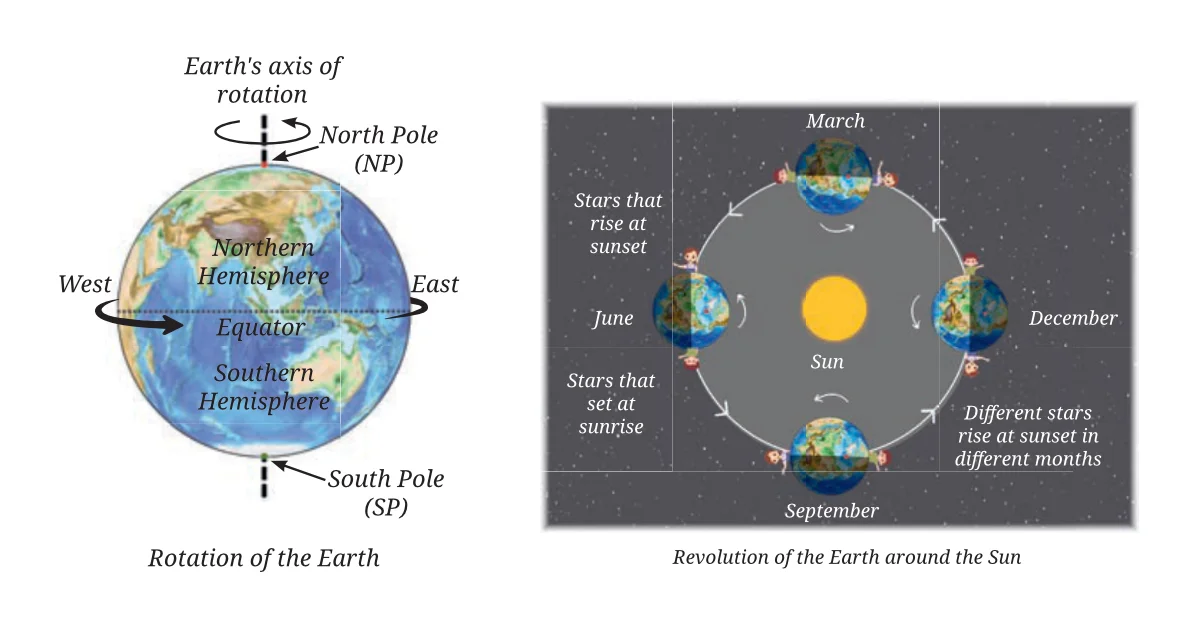
Figure: Sunlight falls on half of Earth’s surface (shows axis and sunrays).
Fun fact: Stars in night sky also appear to move due to Earth’s rotation. A scientist named Foucault proved this with a long swinging pendulum (Foucault pendulum).
12.2 Revolution of the Earth
- While spinning (rotation), Earth also revolves (moves) around the Sun.
- Revolution = one object going around another.
- Path = orbit (almost circular).
- One full revolution = 365 days + 6 hours (1 year).
12.2.1 Changing view of night sky
- As Earth revolves, we face different stars every month.
- Same stars do NOT rise at sunset every night – they change slowly over the year.
Key point: Stars you see at night depend on which way Earth is facing the sky during its journey around the Sun.
Figure: Revolution of Earth around Sun – changing night sky (stars in March, June, September, December).
12.2.2 Seasons on the Earth
- Earth’s axis is tilted (not straight up).
- Tilt stays the same as Earth revolves.
- This tilt + round shape of Earth = seasons!
How seasons happen (easy steps):
- In June (for us in Northern Hemisphere like India): North Pole tilts towards Sun → more sunlight, longer days → Summer.
- Sunrays fall straight and spread over smaller area → hotter.
- Days longer than 12 hours.
- In December: North Pole tilts away from Sun → less sunlight, shorter days → Winter.
- Opposite in Southern Hemisphere (Australia has summer in December!).
- Equinox (21 March & 23 September): 12 hours day + 12 hours night everywhere.
- Solstice: Longest day (21 June) or shortest day (22 December) in Northern Hemisphere.
Wrong ideas people have:
- “Earth is closer to Sun in summer” → NO! Distance change is tiny.
- Actual reason = tilt of axis.
Figure: Earth positions around Sun showing seasons and tilt.
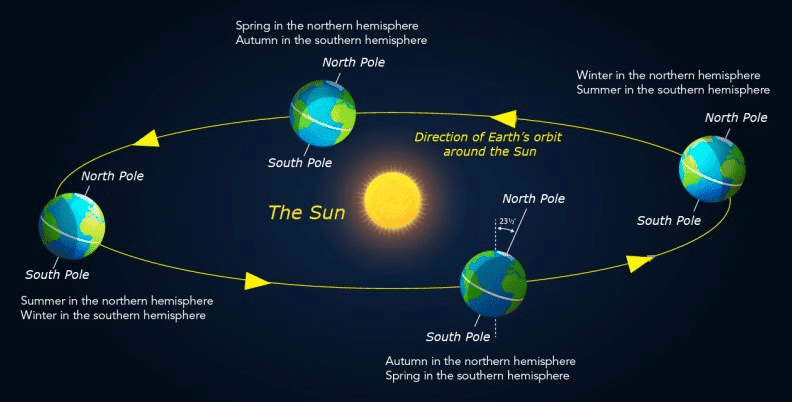
Figure: Earth revolution with seasons (summer in north, winter in south).
Remember tip: “North tilts towards Sun = Summer for us (June). North tilts away = Winter (December).”
12.3 Eclipses
Sun, Moon, and Earth sometimes line up perfectly and block light → eclipses.
12.3.1 Solar Eclipse
- Moon comes between Sun and Earth.
- Moon’s shadow falls on Earth.
- Total solar eclipse: Moon completely covers Sun → day becomes dark for a few minutes.
- Partial solar eclipse: Only part of Sun is covered.
Why can small Moon cover big Sun? Moon is much closer to Earth than Sun, so it looks almost same size in sky (apparent size).
Activity: Hold your thumb in front of a friend’s head – thumb covers head even though smaller!
Safety: NEVER look directly at Sun during eclipse (even with sunglasses). It can damage eyes. Watch with special filters or at planetarium events.
Figure: Solar eclipse – total and partial (Sun, Moon, Earth positions).
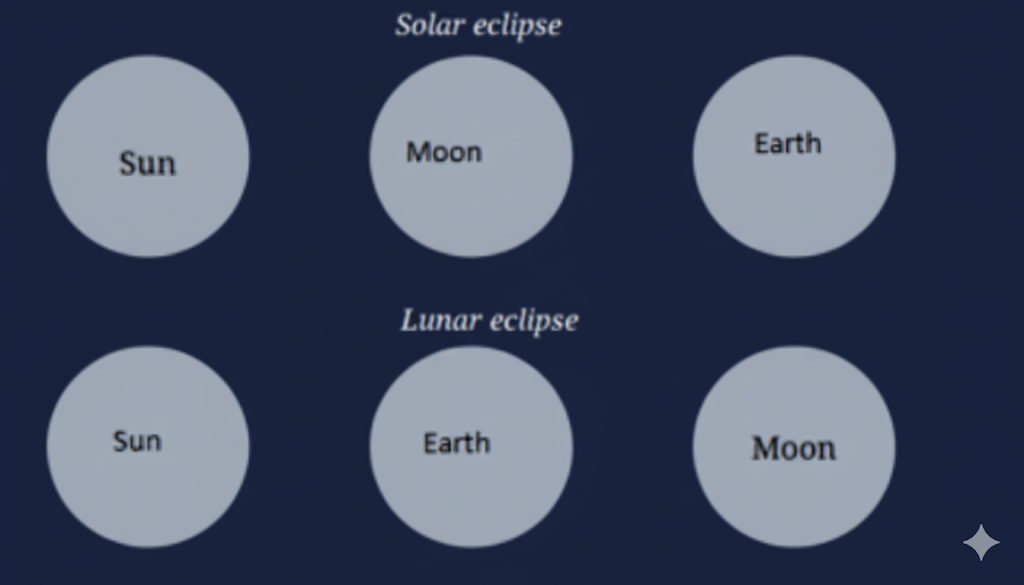
Figure: Geometry of solar eclipse (shadow on Earth).
12.3.2 Lunar Eclipse
- Earth comes between Sun and Moon.
- Earth’s shadow falls on Moon.
- Total lunar eclipse: Whole Moon in shadow → Moon looks dark red (because some red light bends through Earth’s atmosphere).
- Partial lunar eclipse: Only part of Moon in shadow.
Easy to watch: You can see lunar eclipse safely with naked eyes!
Figure: Lunar eclipse geometry (Sun – Earth – Moon).

Remember tip: Solar = Moon blocks Sun (daytime eclipse). Lunar = Earth blocks Moon (nighttime eclipse, Moon turns reddish).
Quick Revision – Easy to Remember Points (A-Z style)
- Apparent movement of Sun → because of Earth’s Rotation (West to East).
- Day & Night → half Earth lit, half dark.
- Eclipses → perfect line-up of Sun, Moon, Earth.
- Lunar eclipse → safe to watch, Moon turns red.
- Northern Hemisphere summer → June (tilt towards Sun).
- Orbit → path of revolution around Sun.
- Rotation = 24 hours spin; Revolution = 365 days journey.
- Seasons → due to tilt of Earth’s axis.
- Solar eclipse → dangerous for eyes, use filters.
Key words to memorise: Rotation (spin), Revolution (orbit), Tilt (seasons), Apparent size (eclipses), Shadow (eclipses).
Practice the globe + torch activity at home – it makes everything crystal clear! This chapter shows how amazing our Earth, Moon, and Sun system is. Keep observing the sky – you will see these things happening live! 🌍☀️🌕