Class 7 Science Curiosity (New Book 2026-27) – Chapter 10: Life Processes in Plants
These notes are made super simple, with short points, tables, mnemonics, and “Remember This” boxes so you can revise fast. Everything is based exactly on the NCERT Curiosity textbook. No extra stuff – only what is in the chapter!
1. Why Do Plants Need Food? (Introduction)
- All living things grow and need food for energy.
- Animals eat food directly.
- Plants make their own food (they don’t eat like us!).
- Food gives nutrients (carbs, proteins, etc.) + water → growth.
- Key Question: How do plants get their food? → Through photosynthesis (main life process).
Remember This: Plants = Self-cookers! They cook food using sunlight.
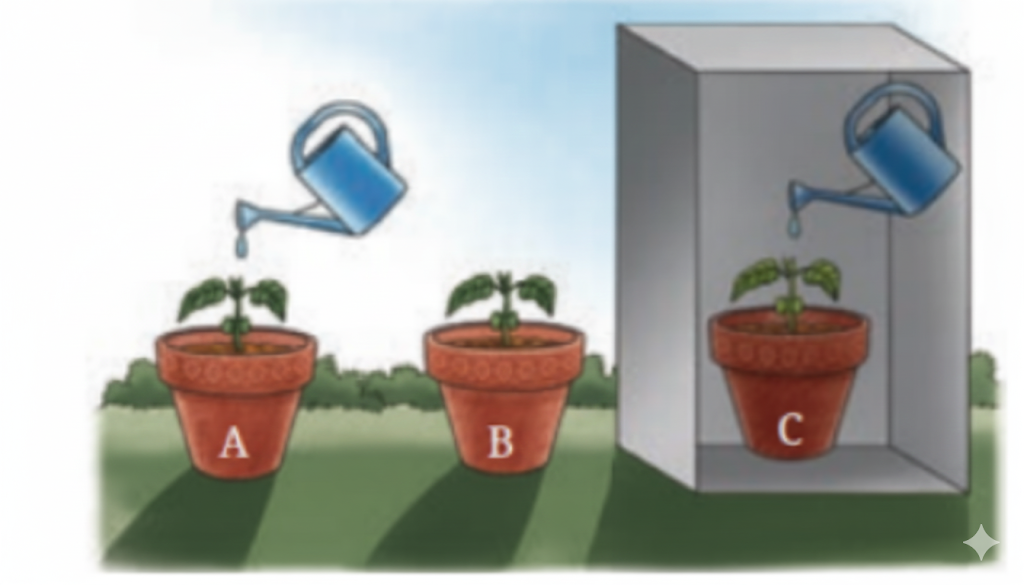
2. 10.1 How Do Plants Grow? (Activity 10.1 – Super Easy Experiment)
What we did:
- 3 same pots + same small plants (chilli/tomato).
- Pot A: Sunlight + Water every day.
- Pot B: Sunlight + No water.
- Pot C: Dark room + Water every day.
- Wait 2 weeks → measure height, leaves, colour.
What we saw (Table summary):
| Pot | Sunlight | Water | Growth after 2 weeks | Leaves colour |
|---|---|---|---|---|
| A | Yes | Yes | Best (tall, many leaves) | Green |
| B | Yes | No | Died or very poor | Yellow |
| C | No | Yes | Poor (less height, fewer leaves) | Yellow |
What we learnt:
- Plants need both sunlight + water to grow well.
- No water → plant dies fast.
- No sunlight → plant becomes weak and yellow.
Mnemonic: S + W = GROW (Sun + Water = Good Growth) Remember This: Pot A wins every time!
3. 10.2 How Do Plants Make Food? (Leaves = Food Factories)
- Plants store food as starch (a carbohydrate).
- Leaves are green because of chlorophyll pigment (green colour).
- Leaves are broad & flat → catch more sunlight.
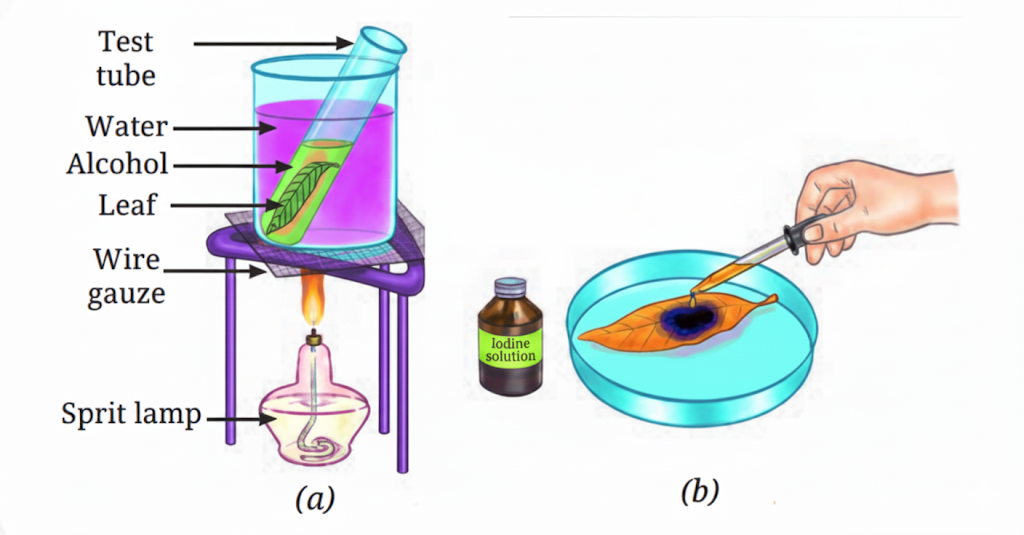
Activity 10.2: Starch Test (Iodine Test – Demo by Teacher)
- Boil leaf in water (soften it).
- Put in alcohol + heat → leaf becomes colourless (removes green colour).
- Add iodine drops → blue-black colour = starch present.
Why decolourise? So we can clearly see blue-black colour. Learnt: Green leaves have starch → chlorophyll helps make starch.
Activity 10.3: Green vs Non-green Patches + Sunlight vs Dark
- Took leaves with green + white patches.
- One plant in sunlight, one in dark (36 hours).
- Iodine test.
Result (Table 10.2):
- Sunlight plant: Green patches → blue-black (starch made).
- Dark plant: No change (no starch).
- Non-green patches → no starch anywhere.
Learnt: Chlorophyll + Sunlight both needed for starch.
10.2.2 Role of Air (Carbon Dioxide)
Activity 10.4 (Teacher demo):
- Destarch plant (keep in dark 2-3 days).
- Half leaf inside bottle with caustic soda (NaOH absorbs CO₂).
- Keep in sunlight.
- Iodine test: Outside half → starch (blue-black); Inside half → no starch.
Learnt: Carbon dioxide (from air) is must for food making.
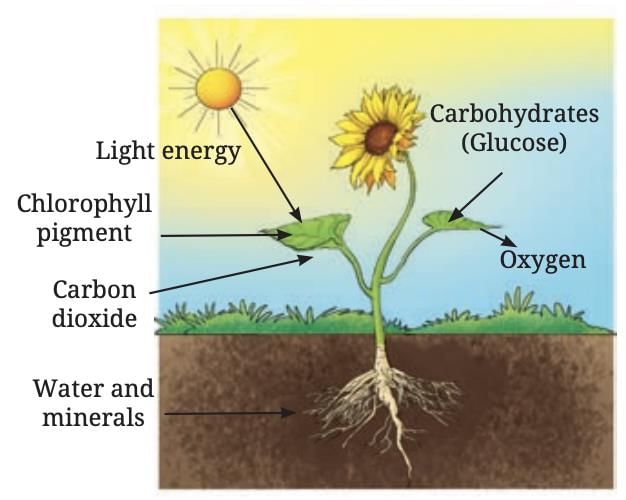
Big Conclusion → Photosynthesis Green leaves use:
- Sunlight
- Water (from roots)
- Carbon dioxide (from air)
- Chlorophyll → make glucose (food) + release oxygen.
Word Equation (Easy to remember): Carbon dioxide + Water → Glucose + Oxygen (in presence of Sunlight + Chlorophyll)
Mnemonic: COWS = CO₂ + H₂O → Glucose + O₂ (Sun + Chlorophyll)
Activity 10.5: Oxygen Release (Bubbles Experiment)
- Hydrilla plant in test tube + inverted tube in water.
- Sunlight → air bubbles come out.
- Gas collected → burns with bright flame → oxygen gas!
Learnt: Photosynthesis releases oxygen (only in sunlight).
10.2.4 How Leaves Exchange Gases?
Activity 10.6 (Microscope):
- Peel lower side of leaf (Rhoeo/Money plant).
- See under microscope → tiny pores called stomata.
Remember This: Stomata = Doors for CO₂ in & O₂ out (also for water vapour).
4. 10.3 Transport in Plants (How Food & Water Move)
10.3.1 Water + Minerals Transport
Activity 10.7 (Red Ink Experiment):
- White flower plant in red-ink water.
- Next day → stem, leaves, flowers turn red.
- Cut stem → red colour in thin tubes.
Learnt: Water + minerals go up through xylem (pipe-like tubes).
10.3.2 Food Transport
- Food (glucose) made in leaves → goes to all parts through phloem.
- Extra food stored in roots, seeds, fruits as starch.
Diagram Summary:
- Xylem → upward (water + minerals from roots).
- Phloem → all directions (food from leaves).

Mnemonic: X for Up (Xylem) like X-ray going up; P for food (Phloem) like Postman delivering food.
5. 10.4 Do Plants Respire? (Yes!)
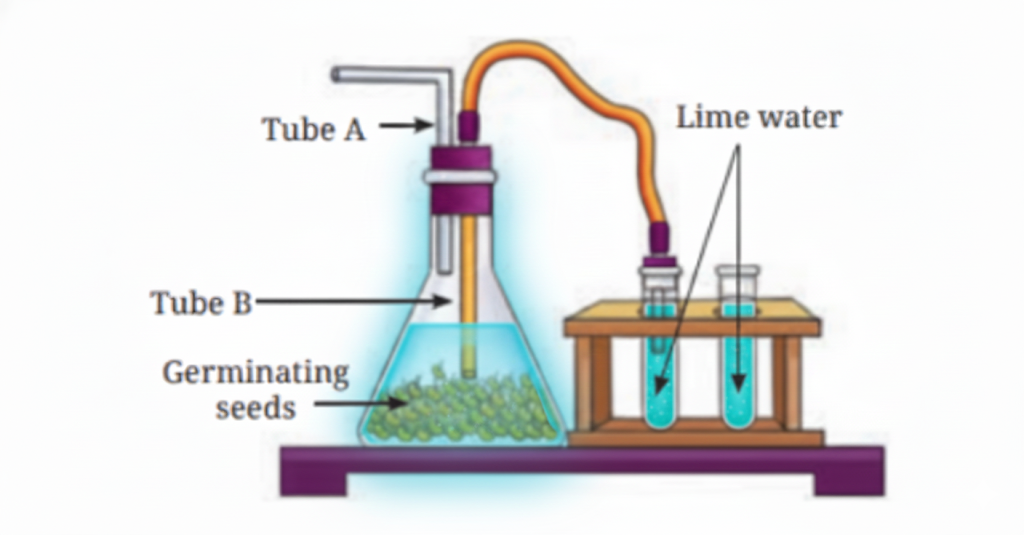
Activity 10.8 (Germinating Seeds + Lime Water):
- Soaked moong seeds in flask → 24 hrs dark.
- Connect to lime water → lime water turns milky.
- Reason: Seeds release CO₂ during respiration.
Word Equation: Glucose + Oxygen → Carbon dioxide + Water + Energy
Learnt:
- All parts of plant (green or non-green) respire.
- Respiration gives energy for growth.
- Happens all the time (day + night).
In a Nutshell (Quick Revision – Memorise These 6 Points)
- Plants make food by photosynthesis (leaves = food factories).
- Needs: Sunlight + Chlorophyll + CO₂ + Water → Glucose + Oxygen.
- Stomata help in gas exchange.
- Xylem carries water + minerals up.
- Phloem carries food everywhere.
- Plants respire too → Glucose + O₂ → CO₂ + H₂O + Energy.
Easy Flowchart (Draw this in notebook): Sunlight + CO₂ + H₂O + Chlorophyll (in leaf) ↓ (Photosynthesis) Glucose (food) + O₂ ↓ (Transported by Phloem) Used for growth + stored as starch ↓ (Respiration in all parts) Energy released
You now have complete A-Z notes of the entire chapter – ready for exams! Revise the mnemonics and tables daily for 10 minutes. You will remember everything easily. Happy learning! 🌱