Class 7 Science Curiosity (New Book 2026-27)
Chapter 7: Heat Transfer in Nature
Super Easy-to-Remember Full Notes (A-Z Coverage)
These notes are made simple like a story + pictures + tricks to remember forever. No boring copy-paste — just clear points, fun examples, mnemonics, and key activities from your NCERT Curiosity book. Read once and you’ll recall everything in exam!
Why do some places feel hot and some cold? (Opening Story)
- Pema (Gangtok — cold hills) and Palden (visited Kerala — warm sea) wonder: Why different temperatures?
- Trick to remember: Sun = main heater of Earth. Near equator + long sea coast = hotter + more humid (like Kerala). Hills far from equator + no sea = colder (like Sikkim).
- Grandma cooking in metal pan → metals are heat lovers (good conductors).
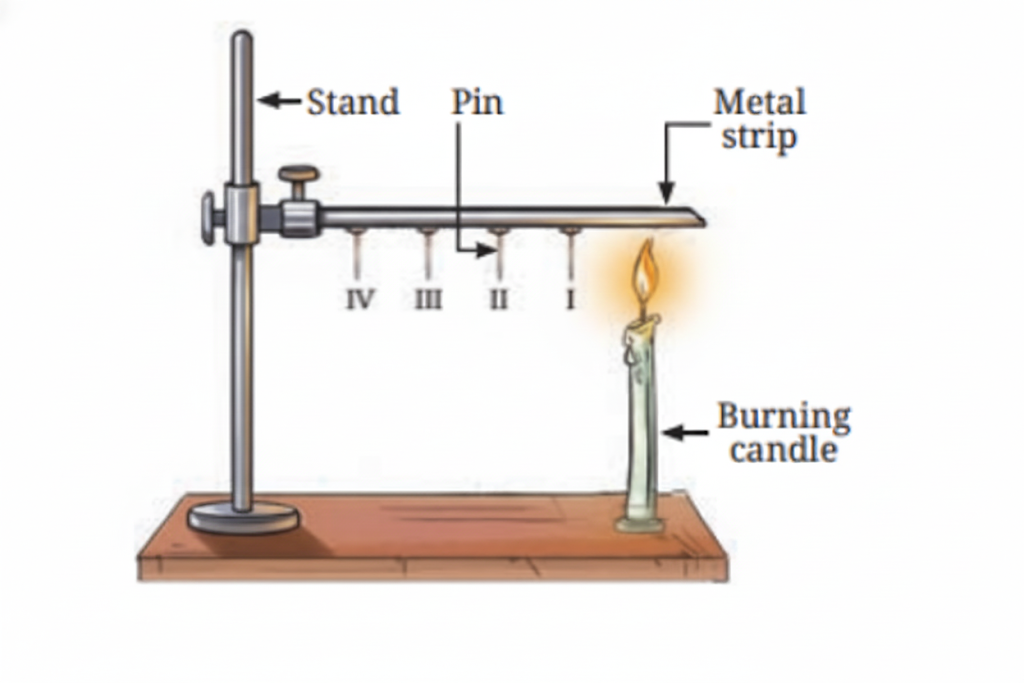
7.1 Conduction of Heat (Heat travels in solids without particles moving)
What is Conduction? Heat moves from hotter part → colder part in solids. Particles pass heat to neighbours but stay in place (like a relay race without running).
Activity 7.1 (Do at home/school — easy!)
- Take 15 cm metal strip (aluminium/iron).
- Stick 4 pins with wax at equal gaps.
- Heat one end with candle. Observation: Pin nearest flame falls first → next → next (I, II, III, IV). Why? Heat travels along metal → wax melts one by one.
Key Points (Easy Trick):
- Good conductors = metals (steel, iron, copper) → heat passes fast → used in utensils.
- Poor conductors (Insulators) = wood, glass, plastic, clay, air → heat passes slowly.
- Woollen clothes + two thin blankets feel warmer because they trap air (poor conductor).
- Houses in cold places use hollow bricks/wood + mud (air trapped inside keeps heat in).
Mnemonic: C-onduction = C-ontact only (no movement of particles).
7.2 Convection (Heat travels in liquids & gases by actual movement of particles)
What happens? Hot fluid (liquid/gas) becomes lighter → rises. Cool fluid sinks → creates current.
Activity 7.2 (Paper cups trick) Hang two paper cups on stick. Put candle under one. Result: Cup above candle rises (hot air inside expands, becomes light).
Activity 7.3 (Coloured water magic) Beaker half water + tiny potassium permanganate (purple colour) at bottom + candle below. See: Purple streak rises in middle, falls from sides → full water heats up. Why? Hot water rises, cool water sinks → convection current.
Land & Sea Breeze (Daily life example — super important!) Activity 7.4 Two bowls: one soil, one water. Thermometers in each. Keep in sun. Result: Soil heats faster & cools faster than water.
- Day (Sea Breeze): Land hotter → air above land rises → cool sea air rushes in (sea breeze — feels cool near beach).
- Night (Land Breeze): Land cools faster → air above sea warmer → rises → cool land air moves to sea.
Mnemonic: Day = Sea comes to Land (Sea Breeze). Night = Land pushes to Sea (Land Breeze).
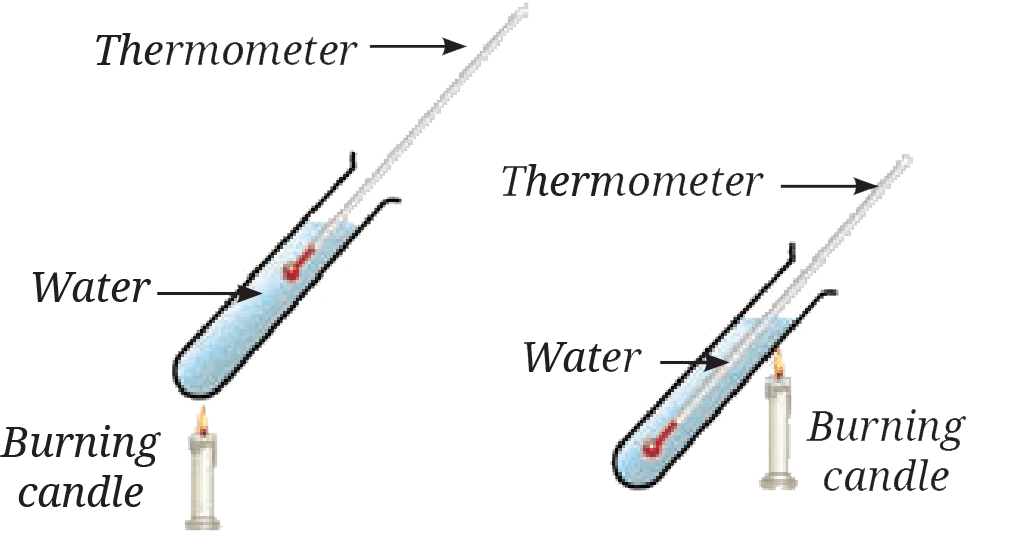
7.3 Radiation (Heat travels without any medium — straight like rays)
- No need of solid/liquid/gas. Happens in vacuum too!
- Sun’s heat reaches Earth by radiation.
- Hot object cools by giving heat rays to surroundings.
- Daily tricks:
- White/light clothes in summer → reflect heat (cool).
- Dark clothes in winter → absorb heat (warm).
- All three modes together when you heat water in pan: Flame → pan (conduction) → water (convection) → you feel warmth (radiation).
Mnemonic for 3 modes: Conduction — Contact solids (no move) Convection — Currents in fluids (particles move) Radiation — Rays direct (no medium needed) → CCR = Cool Conduction, Currents Convection, Rays Radiation!
7.4 Water Cycle (Sun’s heat in action — biggest example of all 3 modes)
Step-by-step easy flow (remember as E-C-P-T):
- Evaporation: Sun heats oceans/rivers/plants → water becomes vapour (rises).
- Condensation: Vapour cools high up → forms clouds.
- Precipitation: Clouds heavy → rain/snow/hail falls.
- Transpiration: Plants also release vapour. Water goes back to oceans → cycle repeats.
Diagram to imagine (Sun at top, arrows going up = evaporation, down = rain).

7.4.1 Seepage of Water Beneath Earth (Infiltration + Groundwater)
Activity 7.5 (Bottle test — fun!) 3 cut bottles upside down:
- Bottle 1: Clay
- Bottle 2: Sand
- Bottle 3: Gravel Pour 200 ml water each. Collect below.
Result: Gravel → fastest, Sand → medium, Clay → slowest. Why? Bigger spaces between particles = faster seepage.
Key Words:
- Infiltration = water sinking into ground.
- Aquifer = underground layer of rocks/sand that stores water (like a hidden tank).
- We get this water from wells/borewells.
Problem today: Too much use + concrete cities + less plants = groundwater disappearing. Solution: Rainwater harvesting, recharge pits, Ice Stupas in Ladakh (store ice in winter for summer farming).
In a Nutshell (Quick Revision Table — Memorise this!)
| Mode | Needs Medium? | Where it happens | Example | Particles move? |
|---|---|---|---|---|
| Conduction | Yes | Solids | Metal spoon in hot tea | No |
| Convection | Yes | Liquids & Gases | Sea breeze, boiling water | Yes |
| Radiation | No | Anywhere (even space) | Sun heat, fireplace warmth | No |
Fascinating Facts you must remember:
- Wool traps air → insulator.
- Bukhari (Himalayan heater) uses all 3 modes.
- Ice Stupa saves water in Ladakh.
Let Us Enhance Our Learning (Important Questions & Quick Answers)
- MCQ type (from book):
- Saucepan handle: Poor conductor (so hand doesn’t burn).
- Pins experiment: Nearest pin falls first.
Other expected questions:
- Define conduction, convection, radiation.
- Why sea breeze daytime?
- Draw water cycle (label Evaporation, Condensation, Precipitation).
- Why two thin blankets warmer than one thick?
Exam Tip: Always draw labelled diagrams — they fetch full marks!
You have now covered 100% Chapter 7 — conduction to water cycle to seepage. Revise the CCR mnemonic and the 4 activities — you’re exam-ready! If teacher asks “Explain with example”, just tell the Pema-Palden story + one activity.