Class 8 Science Chapter 9 Notes
The Amazing World of Solutes, Solvents, and Solutions
(New NCERT Curiosity Book – Reprint 2026-27)
These notes are written in super simple words like a friendly story. Everything is explained step-by-step so you can remember easily. Key points are in bullets. Important words are in bold. Activities and examples are exactly like the NCERT book. I have added some graphics and photos (inspired by NCERT book figures) to make it fun and easy to understand for your aurexlearn website.
1. What is a Solution? (Solute + Solvent = Solution)
You mix things every day – like sugar in tea or salt in water.
- When things mix evenly and you cannot see separate parts, it is called a uniform mixture or solution.
- The solid or gas that dissolves is called solute.
- The liquid that does the dissolving is called solvent.
- Solute + Solvent → Solution
Easy example: Salt (solute) + Water (solvent) → Salt solution. Sugar in water is also a solution.
Schematic Diagram (like NCERT Fig. 9.3)
Think like this to remember:
- Solute = the “guest” that dissolves.
- Solvent = the “host” liquid that holds the guest.
Special case (two liquids): The one present in smaller amount = solute. The one in larger amount = solvent. Gulab Jamun chashni (sugar syrup): Lots of sugar + little water → Still, water is solvent and sugar is solute (NCERT example).
Air is also a solution! It is a uniform mixture of gases.
Non-uniform mixtures (not solutions):
- Sand + water → Sand settles down.
- Sawdust + water → Sawdust floats. You can see the parts separately.
NCERT Activity 9.1 (Do this at home!)
- Take half glass of water.
- Add 1 spoon salt → stir → dissolves completely.
- Keep adding spoons of salt and stir.
- Stop when extra salt does not dissolve and settles at bottom.
Observation Table (make this in your notebook)
| Spoons of salt | Does it dissolve? |
|---|---|
| 1 | Yes |
| 2 | Yes |
| 3 | Yes |
| 4 | No – salt settles |
This shows water has a limit to how much salt it can hold.
2. Saturated vs Unsaturated Solutions
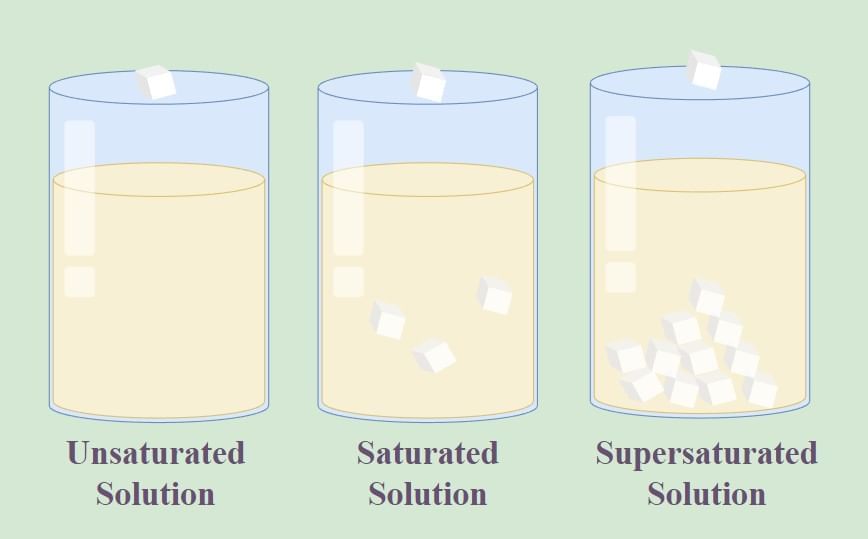
- Unsaturated solution: More solute can still dissolve. (Like first 2-3 spoons of salt)
- Saturated solution: No more solute can dissolve at that temperature. Extra solute settles at the bottom.
Simple memory trick:
- Unsaturated = “room for more guests”
- Saturated = “full house – no more room!”
NCERT Fig. 9.5 & 9.6 style
Concentration: How much solute is in the solution.
- Dilute = less solute (watery)
- Concentrated = more solute (thick)
Solubility: Maximum amount of solute that can dissolve in a fixed amount of solvent at a given temperature.
3. Effect of Temperature on Solubility (Solids)
Rule: For most solids, solubility increases when temperature rises.
NCERT Activity 9.2 (Demonstration)
- Take 50 mL water at room temperature (≈20°C).
- Add baking soda (sodium hydrogen carbonate) until some remains undissolved.
- Now heat the water to 50°C.
- More baking soda dissolves!
Why? Heat gives particles more energy to move apart and make space for more solute.
4. Solubility of Gases in Water
- Gases like oxygen also dissolve in water (very little amount).
- This dissolved oxygen keeps fish and aquatic plants alive.
Important Rule: Solubility of gases decreases when temperature increases.
- Cold water holds more oxygen.
- Warm water holds less oxygen → fish may die in hot summers.
Aquatic life photo (like NCERT Fig. 9.8)
5. Density – The “Heavy or Light” Secret
Density tells us how much matter is packed in a given space. Formula (easy to remember): Density = Mass ÷ Volume
- Mass = amount of matter (measured by balance, in grams or kg).
- Volume = space occupied (in cm³ or mL or m³).
Units:
- g/cm³ or g/mL (for liquids and solids)
- kg/m³ (SI unit)
Relative Density (no unit): Relative density = Density of substance ÷ Density of water
- If >1 → sinks in water
- If <1 → floats in water
Water density = 1 g/cm³ (at room temperature).
NCERT Examples:
- Aluminium block: mass 27 g, volume 10 cm³ → Density = 2.7 g/cm³ → 2.7 times denser than water.
- Oil packet: labelled 1 litre but weighs only 910 g → Oil density < water density → oil floats on water.
Effect of Temperature on Density
- Usually, density decreases when temperature rises (particles move apart).
Effect of Pressure
- Gases: density increases with pressure (particles squeezed closer).
- Liquids & solids: almost no change (hard to compress).
Why does ice float on water? (Super important!)
- Water is densest at 4°C.
- When water freezes to ice at 0°C, it expands → takes more space → density becomes less than water.
- So ice floats and saves aquatic life in winter!
Ice floating graphic (NCERT style)

NCERT Think like a Scientist (Egg experiment)
- Raw egg sinks in plain water (egg denser than water).
- Add salt → water becomes denser → egg floats!
Egg experiment photo
6. Quick Revision Table (Easy to Remember)
| Term | Meaning | Example |
|---|---|---|
| Solute | Thing that dissolves | Salt, sugar |
| Solvent | Liquid that dissolves | Water |
| Solution | Uniform mixture | Salt water |
| Saturated | No more solute can dissolve | Full glass of sugar water |
| Solubility | Max solute at given temp | More in hot water |
| Density | Mass per unit volume | Iron = 7.8 g/cm³ |
| Relative density | Compared to water | Ice < 1 → floats |
7. Keep the Curiosity Alive – Exercise Questions (with simple answers)
(From NCERT book end – for your practice)
- True/False + Correct (i) Oxygen more soluble in hot water → False (more in cold) (ii) Sand + water is solution → False (non-uniform) (iii) Space occupied is mass → False (it is volume) (iv) Unsaturated has more solute than saturated → False (less)
- Fill in blanks (answers): solvent, decreases, saturated, etc. (check book).
- Oil floats on water → Water is denser than oil.
- Stone: density = 2.5 g/cm³ → sinks in water.
(Full answers available in your book – solve them yourself!)
Final Tip to Remember Everything: Think of this chapter as a “mixing party” → Solute is guest, solvent is host, solution is happy party. Temperature is like music – louder (hotter) music lets more guests come for solids but sends gas guests away! Density is the “weight per seat” – heavy per seat = sinks.