Class 8 Science Curiosity Chapter 10: Light - Mirrors and Lenses
Full Easy Notes (2026-27 New Book)
Simple words, short points, easy to remember like a story. No tough words. Just read once and recall!1. Fun Start: Why Mirrors Look Weird Sometimes?
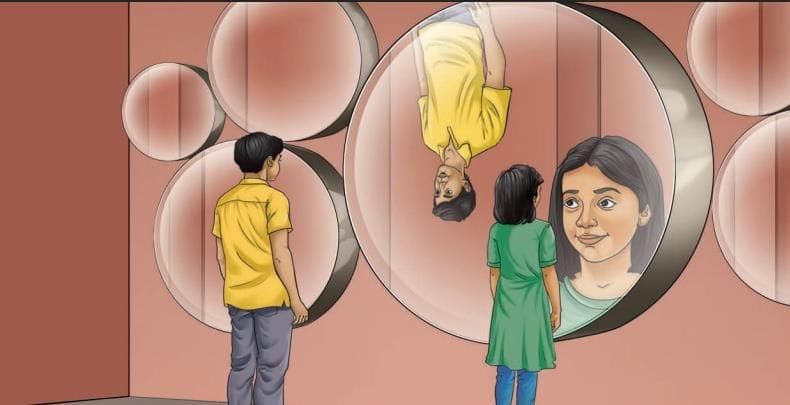
Imagine Meena at a science centre. She sees curved mirrors. Her face looks BIG, then upside down, then tiny! Normal flat mirror (plane mirror) always gives same-size, straight image. But curved mirrors change the image size and direction. Why? Because they are spherical mirrors – like part of a round ball!
Easy Tip to Remember: Spoon in kitchen = free mirror experiment! Inner side = concave, outer side = convex.
2. What are Spherical Mirrors? (Two Types)
- Concave Mirror: Reflecting surface bends inwards (like a cave or inner spoon).
- Convex Mirror: Reflecting surface bends outwards (like outer spoon or hill).
Activity 10.1 (Do at home – Super Easy!) Take a shiny spoon.
- Look in inner curved part → Image upside down (inverted).
- Look in outer curved part → Image small and straight (erect). Move spoon away → Image changes!
Pictures from book style:
- Fig: Inner spoon → inverted face.
- Fig: Outer spoon → small erect face.

Remember in 1 line: Concave = bends in (like ) , Convex = bends out (like ) .
3. How to Tell Concave from Convex? (Activity 10.2)
Put mirrors on table, look from side:
- Concave → looks like a bowl (curved in).
- Convex → looks like a ball (bulges out).
Easy Test: If image is bigger and straight when close → Concave. If image is always smaller and straight → Convex.
4. What Kind of Images Do Spherical Mirrors Make? (Activity 10.3)
Keep object (toy) in front of mirrors.
For Concave Mirror:
- Close object → Big straight image (enlarged, erect).
- Far object → Upside down image (inverted), first big then small.
For Convex Mirror:
- Always straight (erect) and smaller (diminished).
- Never upside down.
Plane Mirror (for comparison): Always same size, straight, no change.
Key Point (Easy Table to Remember):
| Mirror Type | Image when object is CLOSE | Image when object is FAR | Size | Straight or Upside down? |
|---|---|---|---|---|
| Concave | Big + straight | Upside down | Changes | Both |
| Convex | Small + straight | Small + straight | Always small | Always straight |
| Plane | Same size + straight | Same size + straight | Same | Always straight |
Lateral inversion (left-right swap) happens in ALL mirrors.
5. Ray Diagrams – Super Easy Way to Draw Images (Class 8 Style)
We use 2-3 special rays to find where image will form.
Rules for Concave Mirror (Remember as C-F-P):
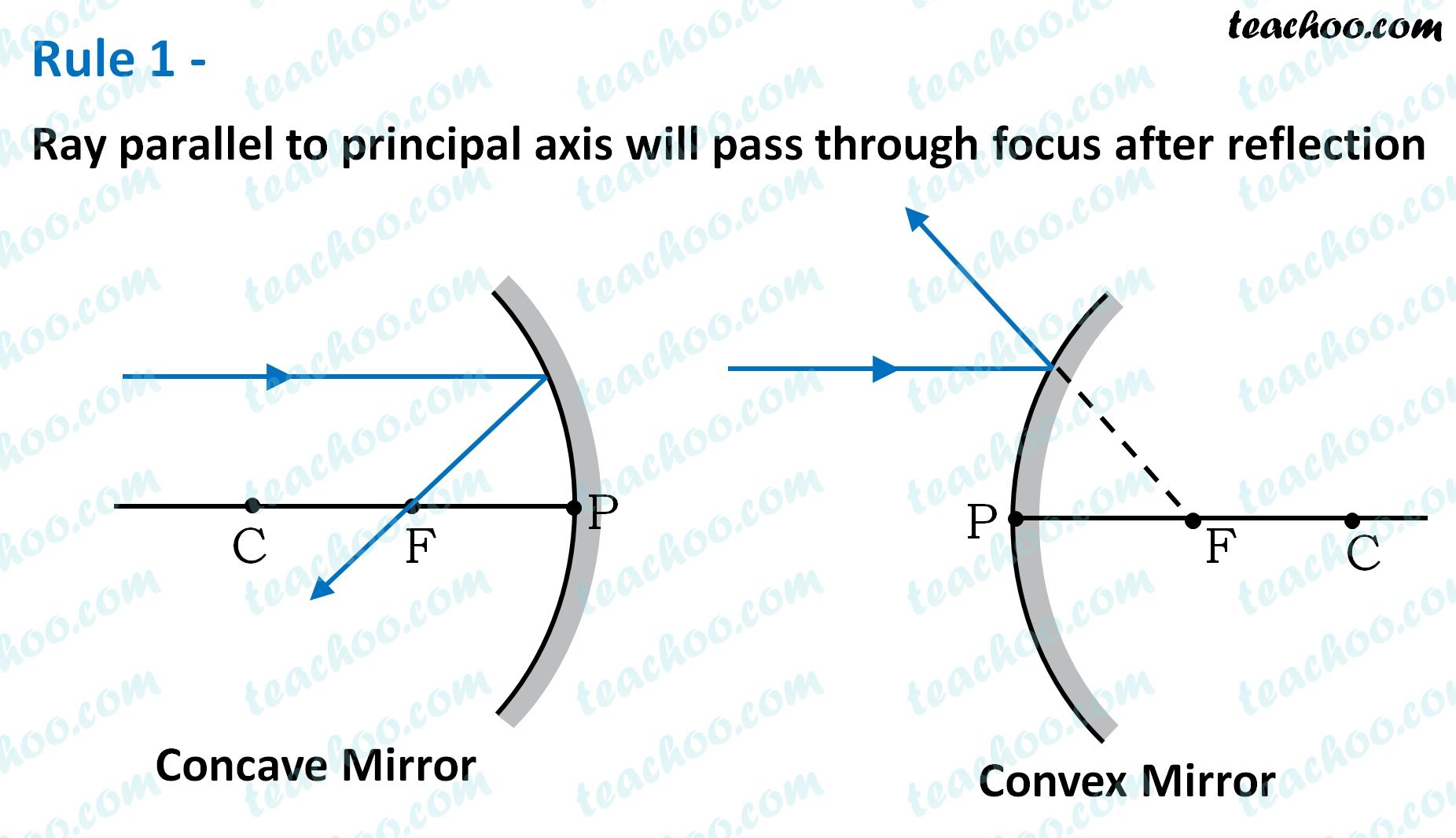
- Ray parallel to axis → passes through Focus (F) after reflection.
- Ray through Centre of Curvature (C) → reflects back on same path.
- Ray through Focus (F) → reflects parallel to axis.
For Convex Mirror: Same rules but rays diverge (spread out) after reflection. We extend them back to find image.
Easy Mnemonic: "Parallel ray hugs Focus after bounce!"
(Real book has beautiful ray diagrams – draw them 2 times and you will never forget.)
6. Uses of Spherical Mirrors (Daily Life Examples)
Concave Mirrors:
- Torch, car headlights → makes strong parallel beam.
- Dentist mirror → big close view of teeth.
- Solar cooker → focuses sun rays to cook food.
- Shaving mirror → enlarged face.
Convex Mirrors:
- Side mirrors of vehicles → "Objects in mirror are closer than they appear" (wide view, small image).
- Shop security mirrors → see whole shop.
Remember: Concave = converges light (comes together). Convex = diverges light (spreads out).
7. Now Meet Lenses! (Next Big Part of Chapter)
Lenses are also curved like mirrors but made of transparent glass/plastic. They refract (bend) light, not reflect.
- Convex Lens (thicker in middle): Converges light → like magnifying glass.
- Concave Lens (thinner in middle): Diverges light.
Image by Convex Lens:
- Close object → big straight image.
- Far object → small upside-down image.
Image by Concave Lens:
- Always small, straight, virtual image.
Uses:
- Convex: Magnifying glass, camera, projector, spectacles for long-sight.
- Concave: Spectacles for short-sight.
Human Eye works like a convex lens!
- Lens in eye focuses light on retina (screen at back).
- Brain sees upside-down image but flips it for us.
Common Eye Problems (Easy):
- Myopia (short-sight) → concave lens.
- Hypermetropia (long-sight) → convex lens.
Care of Eyes (Must Remember):
- Read in good light.
- Don’t rub eyes.
- Eat carrots, greens (Vitamin A).
- 20-20-20 rule: Every 20 min look 20 feet away for 20 sec.
8. Quick Revision Points (A-Z Super Short for Exam)
- Spherical mirrors = part of hollow sphere.
- Concave = inward curve = converges.
- Convex = outward curve = diverges.
- Image in convex mirror → always small + straight (safety reason).
- Ray diagrams use 2 rays → image position found where rays meet.
- Lenses bend light by refraction.
- Eye lens = convex → focuses on retina.
Activity Summary (Do These!):
- Spoon mirror test.
- Side-view mirror check.
- Draw 4 ray diagrams (2 concave + 2 convex).
Probe & Ponder Questions (Think & Answer):
- Why warning on vehicle mirrors? (Because image is smaller so objects look farther.)
- Why curved line on reading glasses? (Convex lens part for near vision.)
You now have FULL chapter in super simple words! Read 2 times → draw diagrams → you will score 100% in test. Keep your Curiosity alive – go try the spoon trick today! 🌟