Class 8 Science Chapter 11: Keeping Time with the Skies
(NCERT Curiosity Textbook – New Book 2026-27)
This chapter explains how people long ago used the sky (Sun, Moon, stars) to measure time – days, months, years – without clocks or watches. It is all about celestial timekeeping (time from sky objects). The chapter is easy and fun – just observe the sky! We will cover everything in simple words, step-by-step, with easy-to-remember points, examples, and activities. No hard science words.
1. Why Do We Need to Keep Time with the Skies?
- Long ago, there were no clocks or calendars.
- Farmers needed to know when to sow seeds (rainy season).
- People needed to know when festivals or important days would come.
- They watched the Sun (for day), Moon (for month), and stars (for seasons and year).
- Even today, we use sky ideas for calendars and satellites.
Easy tip to remember: Sky = Natural Clock + Calendar.
2. The Moon and Its Phases (Most Important Part!)
The Moon does not shine by itself. It reflects sunlight. We see only the part that faces the Sun and reflects light towards Earth.
Why phases change:
- Moon goes around Earth in about 27.3 days (one orbit).
- But from Earth, full cycle (new Moon to next new Moon) takes 29.5 days (called synodic month).
- Phases depend on the position of Sun – Earth – Moon (not Earth’s shadow!).
Simple way to remember phases (like a clock):
- New Moon (Day 0): Moon between Earth and Sun → dark side faces us → we cannot see it.
- Crescent (small slice): Growing (waxing) or shrinking (waning).
- First Quarter (half Moon, right side lit): 7-8 days after new Moon.
- Gibbous (more than half): Almost full.
- Full Moon (Day 15): Entire face lit → opposite to Sun.
- Then it shrinks back: waning gibbous → last quarter → waning crescent → new Moon again.
Mnemonic to remember: New → Crescent (waxing) → Quarter → Gibbous → Full → Gibbous (waning) → Quarter → Crescent (waning) → New. Repeat every 29.5 days!
Important fact: Phases are NOT caused by Earth’s shadow. Earth’s shadow causes only lunar eclipse (rare).
Here is a clear diagram from the chapter style showing Moon positions and phases:


Activity you can do (from book): Observe Moon every night for one month. Draw what you see. Note the date and time. You will see the cycle yourself!
3. How We Measure Time Without Clocks
- Day: Sun rises in east, sets in west (Earth rotates once in 24 hours).
- Month: Moon’s phases (29.5 days).
- Year: Earth goes around Sun once (365¼ days) → seasons change.
- Sundial: Old tool. Shadow of a stick tells time (short shadow = noon).
- Stars and constellations: Some stars appear at fixed times in seasons. Example: Orion in winter.
Fun fact: Many tribes in India still use stars to know planting time.
4. Calendars – Three Types (Easy Table to Remember)
| Type | Based on | Length | Example | Good for | Problem |
|---|---|---|---|---|---|
| Lunar | Moon phases | 354 days | Islamic calendar (Hijri) | Festivals like Eid | Shifts 11 days every year |
| Solar | Earth around Sun | 365¼ days | Gregorian (our school calendar) | Dates, seasons | Needs leap year |
| Luni-Solar | Both Moon + Sun | Adds extra month | Hindu calendar (Panchang) | Festivals + seasons | Needs “adhik maas” (extra month) sometimes |
Mnemonic: Lunar = Moon only (short year), Solar = Sun only (365 days), Luni-Solar = Both (adds extra month to match).
Here is a simple illustration comparing lunar and solar years:

Why leap year? Solar year is 365.25 days. We add one extra day every 4 years (29 Feb) so dates don’t shift.
5. Festivals and Sky
- Many Indian festivals are based on Moon phases or full Moon (Purnima).
- Example: Diwali on new Moon (Amavasya), Holi on full Moon.
- Sky helped people fix festival dates long ago.
6. Artificial Satellites – Modern Sky Timekeepers
- Man-made objects orbiting Earth.
- Used for:
- TV, phone, internet (communication)
- GPS navigation (maps on phone)
- Weather forecast
- Disaster warning (cyclones, floods)
- Scientific study and Earth photos
ISRO satellites (India’s): Help farmers, fishermen, and disaster management.
Problem: Too many satellites → space debris (old parts floating). It can crash with working satellites. Scientists are trying to clean it.
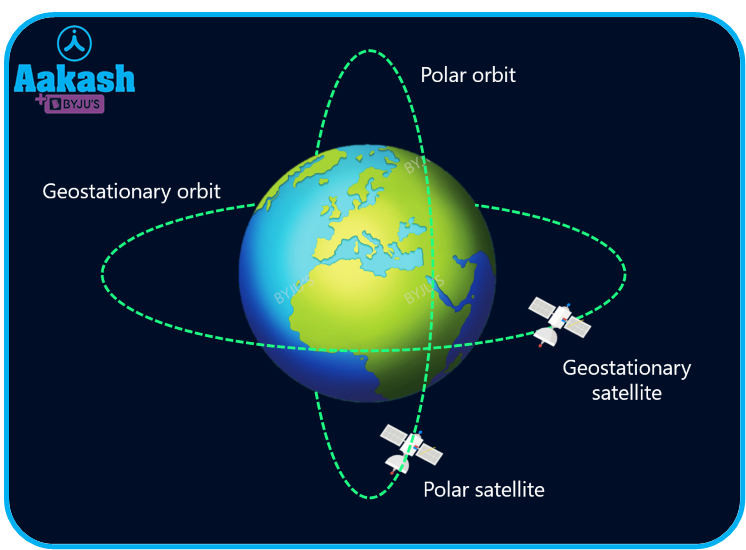
Here is how satellites orbit Earth:
7. Keep the Curiosity Alive – Important Questions & Simple Answers (From Book)
(These come at the end of the chapter – revise these for exams!)
- True/False:
- We see only the part of Moon that reflects sunlight → True
- Earth’s shadow causes Moon phases → False (only eclipse)
- Calendars use repeating sky cycles → True
- Moon only at night → False (can see in day too)
- Amol born on full Moon day – will birthday always be full Moon? No – Moon cycle (29.5 days) and solar year (365 days) don’t match perfectly.
- Name two mistakes in the wrong Moon figure (stars in day + wrong shadow). Answer: Stars not visible in daylight; phases not caused by Earth shadow.
- Match pictures to phases (New Moon, Full Moon, etc.). (Book shows 8 pictures – New Moon is invisible.)
- Malini saw Moon overhead at sunset → First Quarter (waxing, right half lit).
- Who is correct about Moon position? (Ravi vs Kaushalya) → Kaushalya (gibbous in afternoon is possible).
- Moon moving away slowly → Luni-solar calendars will need extra month more often.
- 37 full Moons in 3 years but only 36 months → At least two full Moons in one month (called Blue Moon).
- Moon visible whole night → Full Moon.
Quick Revision Points (Easy to Remember for Exams)
- Phases cycle: 29.5 days (not 27.3).
- Day = Earth rotation, Month = Moon orbit, Year = Earth revolution.
- Calendars fix the mismatch between Moon and Sun cycles.
- Satellites = helpful but create space junk.
- Always observe sky – that is the real science!
Activity Tip: Draw your own Moon calendar for one month. Paste real photos or draw phases. It will help you remember forever.
You now have complete, simple, and full notes of Chapter 11 – from start to end. Read once, revise with diagrams, and you will remember everything easily. Sky watching is the best way to keep curiosity alive! 🌕☀️