Class 6 Science Chapter 4: Exploring Magnets
(NCERT Curiosity Textbook 2026-27 – Full Detailed Notes A-Z)
These notes are made super easy to remember with short points, tables, activities you can do at home, mnemonics, and simple language. Everything is directly from the NCERT Curiosity book (no extra stuff added). Read once, revise with pictures, and you’ll remember forever!
1. Introduction – Why Learn About Magnets?
Reshma (a girl from Kerala) was writing a story about old sailors carrying spices on ships. At night they used stars for direction, but in her story there was a big storm and cloudy sky – no stars! How would sailors find direction?
She discovered magnetic compass – a device that always shows North-South. This made her curious about magnets.
Key Fact to Remember:
- Old magnets = Natural lodestone (found in ancient times).
- Today’s magnets = Artificial (made by humans from iron or other materials).
Easy Mnemonic: Magnets are everywhere – pencil box, fridge door, school duster, toys!
(Fig. 4.1 from book: Pencil boxes, purses, writing boards with magnets attached – common items we see daily.)
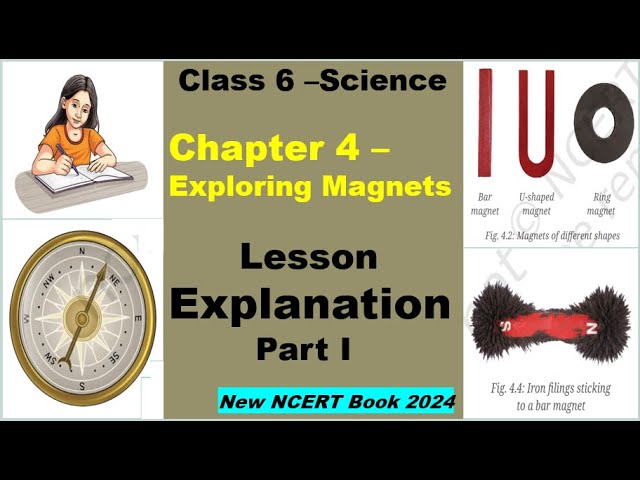
2. Magnets Come in Different Shapes (Fig. 4.2)
- Bar magnet (straight like a rod)
- U-shaped magnet (like a horseshoe)
- Ring magnet (circular like a donut)
Remember: Shape does not matter – every magnet has two poles!
3. Magnetic and Non-Magnetic Materials (Activity 4.1)
Do this at home (very easy!): Take a magnet + objects like pencil (wood), eraser (rubber), iron nail, plastic scale, coin, glass piece, paper clip.
Predict → Bring magnet near → Observe → Fill table like in book.
Result you will see:
- Some stick → Magnetic materials (attracted to magnet).
- Some don’t stick → Non-magnetic materials.
Magnetic materials (stick to magnet): Iron, Nickel, Cobalt + their mixtures. Non-magnetic materials (do not stick): Wood, plastic, glass, rubber, copper, aluminium, paper.
Easy Table to Remember (Table 4.1 style):
| Object | Material | Attracted? (Yes/No) |
|---|---|---|
| Iron nail | Iron | Yes |
| Pencil | Wood | No |
| Paper clip | Steel | Yes |
| Plastic ruler | Plastic | No |
Mnemonic: “Iron, Nickel, Cobalt – INC are Magnetic Friends!”
4. Poles of a Magnet (Activity 4.2)
Super fun experiment (do at home): Spread iron filings on paper → Place bar magnet → Tap gently.
What you see (Fig. 4.4): Maximum filings stick at the two ends (poles). Very few in the middle.
Big Rule (Remember forever):
- All parts of magnet do NOT attract equally.
- Poles = strongest attraction points.
- Every magnet has two poles – North (N) and South (S).
- Poles always come in pairs. You cannot have a single pole!
- Break magnet into 100 pieces → Each small piece still has N + S poles.
Mnemonic: “Poles are like best friends – always together, never alone!”
(Fig. 4.4: Iron filings sticking mostly at the two ends of bar magnet – poles are powerful!)
5. Finding Directions with Magnet (Activity 4.3)
Activity: Hang a bar magnet with thread (freely suspended) → Let it stop → It always points North-South.
Fig. 4.5: Freely suspended bar magnet always rests North-South.
- End pointing North = North pole (North-seeking pole).
- End pointing South = South pole.
Why? Earth itself is like a giant magnet!
Test to check if something is a magnet: Freely suspended iron bar can point any way, but only real magnet points North-South.
6. Magnetic Compass – The Direction Finder (Fig. 4.6)
- Small round box with transparent lid.
- Inside: Thin magnetic needle (red end = North) that rotates freely on a pin.
- Dial has N, E, S, W marked.
- Needle stops → Rotate box so N-S on dial matches needle → All directions known!
How to make your own compass (Activity 4.4 – Do at home!):
- Take iron sewing needle + bar magnet.
- Stroke needle with same pole 30-40 times in one direction (Fig. 4.7a).
- Needle becomes magnet!
- Pass needle through cork → Float in bowl of water (Fig. 4.7b).
- Needle stops pointing North-South → Your compass is ready!
Mnemonic for making: “Stroke, stroke, 40 times – needle becomes magnet, floats and shines!”

(Fig. 4.7 from book: (a) Making needle a magnet by stroking, (b) Homemade compass in water bowl – needle always points North-South.)
7. Attraction and Repulsion (Activity 4.5)
Rule of Magnetism (Most Important – Remember like a rhyme): “Like poles repel, Unlike poles attract.”
Experiment (Fig. 4.8):
- Bring North of one magnet to North of another → They push away (repel).
- Bring North to South → They pull together (attract).
Activity 4.6: Compass needle (also a magnet) behaves same way. Activity 4.7: Magnetic force passes through non-magnetic things (wood, plastic, glass, cardboard) – needle still moves! (Fig. 4.10)
Easy Rhyme to Remember: “Same-same go away (repel), Different-different come and play (attract)!”
(Fig. 4.8: Two bar magnets showing attraction and repulsion.)
8. Fun with Magnets (Activity 4.5 onwards – Try these!)
- Magnetic garland (Fig. 4.11)
- Steel balls in maze – move magnet below cardboard (Fig. 4.12)
- Pick paper clip from water without wetting magnet (Fig. 4.13)
- Two matchbox cars with magnets – like poles facing → they run away! (Fig. 4.14)
Caution – How to keep magnets safe (Very Important):
- Store in pairs (unlike poles together).
- Keep soft iron pieces or wood between them.
- Never heat, drop, hammer or keep near mobile/remote. Mnemonic: “Pair them up, unlike poles, wood in between – magnets stay strong like team!”
9. Keywords (Easy to Revise)
- Magnetic materials
- Non-magnetic materials
- Poles (North & South)
- Attraction
- Repulsion
- Magnetic compass
- Lodestone
10. Quick Summary Points (Revise in 2 minutes)
- Magnets have 2 poles – always together.
- Iron filings stick most at poles.
- Freely suspended magnet → North-South.
- Like poles repel, unlike attract.
- Magnetic force works through non-magnetic materials.
- Compass helps find direction.
- Treat magnets carefully – they lose power if mishandled.
Let’s Enhance Our Learning (Book Questions – Answers in short):
- Fill blanks: (i) attract, repel (ii) magnetic materials (iii) north-south (iv) two
- True/False: (i) F (ii) T (iii) F (iv) T
You now have full A-Z notes – read, do activities, look at pictures, and you will score full marks!
These notes are 100% based on the official NCERT Curiosity book Chapter 4. Keep magnets safe and keep exploring science! 🧲✨